Why does a Retail Media Strategy matter in e-Commerce?
Retail media has become one of the most talked-about topics in e-commerce over the past two years. Marketplaces and retailers are actively promoting it as a growth lever, agencies are building entire practices around it, and brands are allocating increasingly significant budgets to it. Yet for many organizations, a clear definition of what retail media actually is, and a rigorous understanding the impact of a proper retail media strategy, remains elusive.
This matters more than most brands realize. Retail media is not just a marketing channel. It is a financial commitment that sits in a specific part of your P&L, and if it is not monitored correctly, it can quietly erode the profitability of your entire e-commerce business while your net sales figures continue to look healthy.
This post breaks down what retail media is, why it is financially significant in ways that are easy to miss, how to evaluate it properly, and what a smart retail media strategy looks like in 2026.
What Retail Media Actually Is
Retail media is, at its most basic, any media you buy from a retailer, marketplace, or e-commerce platform. This covers a wide range of formats and placements: sponsored product listings, sponsored brand placements, sponsored search ads, display banners on retailer websites, and increasingly, off-platform placements such as Amazon Prime Video or Kindle advertising that reach audiences outside the marketplace environment itself.
The definition is broader than many brands assume, and this breadth is part of what makes retail media complex to manage. Some argue that retail media should only include self-service placements that brands can manage and optimize themselves, distinguishing it from fixed-price placements that are handed over to the retailer to execute. In practice, both types of investment serve the same purpose: driving visibility and sales for your products. Both should therefore be held to the same standard of measurement and accountability.
Why Retail Media Is a Hidden Profitability Risk

Retail media investments, when not properly monitored, could be hard to correct in the long-run. Photo by www.kaboompics.com from Pexels
The less obvious but financially more significant reason retail media matters is where it sits in your P&L, and the fact that most organizations are not monitoring it at the right level.
When brands look at their e-commerce performance, they typically focus on net sales and gross margin. Net sales reflect the difference between list price and trade discounts and rebates. Gross margin includes some additional discount elements, such as chargebacks and returns. Neither of these metrics includes retail media investment. Retail media only appears at the level of customer contribution, which is gross margin minus all marketing costs.
In traditional offline trade, the gap between gross margin and customer contribution is relatively small because most of the commercial investment happens in trade terms rather than in media. In e-commerce, this is fundamentally different. The majority of commercial investment happens below the gross margin line, in retail media and other marketing costs. This means that brands focused solely on net sales and gross margin are making decisions without visibility into a significant portion of their actual e-commerce investment.
The result, which is a pattern seen frequently across e-commerce businesses of all sizes, is that organizations have built large e-commerce channels that look healthy at the gross margin level but are deeply unprofitable once retail media costs are properly accounted for. Because teams have never been trained to monitor customer contribution in e-commerce, the problem compounds over time until it becomes very difficult to fix.
ROAS as your primary KPI?
One of the most common mistakes brands make in retail media is using ROAS, return on ad spend, as their primary measure of campaign performance. ROAS is simply the relationship between your advertising investment and your total sales in a given period. It does not account for the organic sales that would have happened anyway without the campaign. It does not account for price discounts that were running simultaneously. And it does not reflect whether the sales generated were actually profitable.
A campaign can show a strong ROAS while simultaneously being unprofitable, particularly if the brand was heavily discounting its products during the same period and funding those discounts out of its own margin. The more meaningful metric is ROI, return on investment, which measures the actual incremental uplift generated by a campaign against its full cost. This requires having baseline sales data to compare against, which is why building a solid data foundation before scaling retail media investment is so important.
If you do not yet have the historical data to calculate ROI properly, the right approach is to start conservatively and focus on the most targeted placements available, rather than spreading budget across broad, untargeted formats.
The Targeting Principle: Where to Start
When evaluating which retail media formats to invest in, targeting precision is the most reliable indicator of likely return. A homepage banner that every visitor to a retailer’s website sees sounds like significant reach, but only a tiny fraction of those visitors will be in the market for your specific product at that moment. The result is a very high cost per relevant impression and a low probability of conversion.
Contrast this with sponsored search placements, where your product appears in front of a user who has actively searched for a term directly related to what you sell. The user has already signaled purchase intent. You do not need to know anything else about them to know that this is a high-value moment to be visible. This is why sponsored search consistently delivers stronger returns than broad display placements for most brands, particularly those in the early stages of building a retail media program.
As your data grows and your understanding of what works on each platform deepens, you can layer in more sophisticated targeting approaches, including audience-based targeting using social demographics and purchase behavior signals. But the starting point should always be the most targeted formats available, tested and evaluated based on real ROI data before scaling.
The European Retail Media Landscape: An Honest Assessment
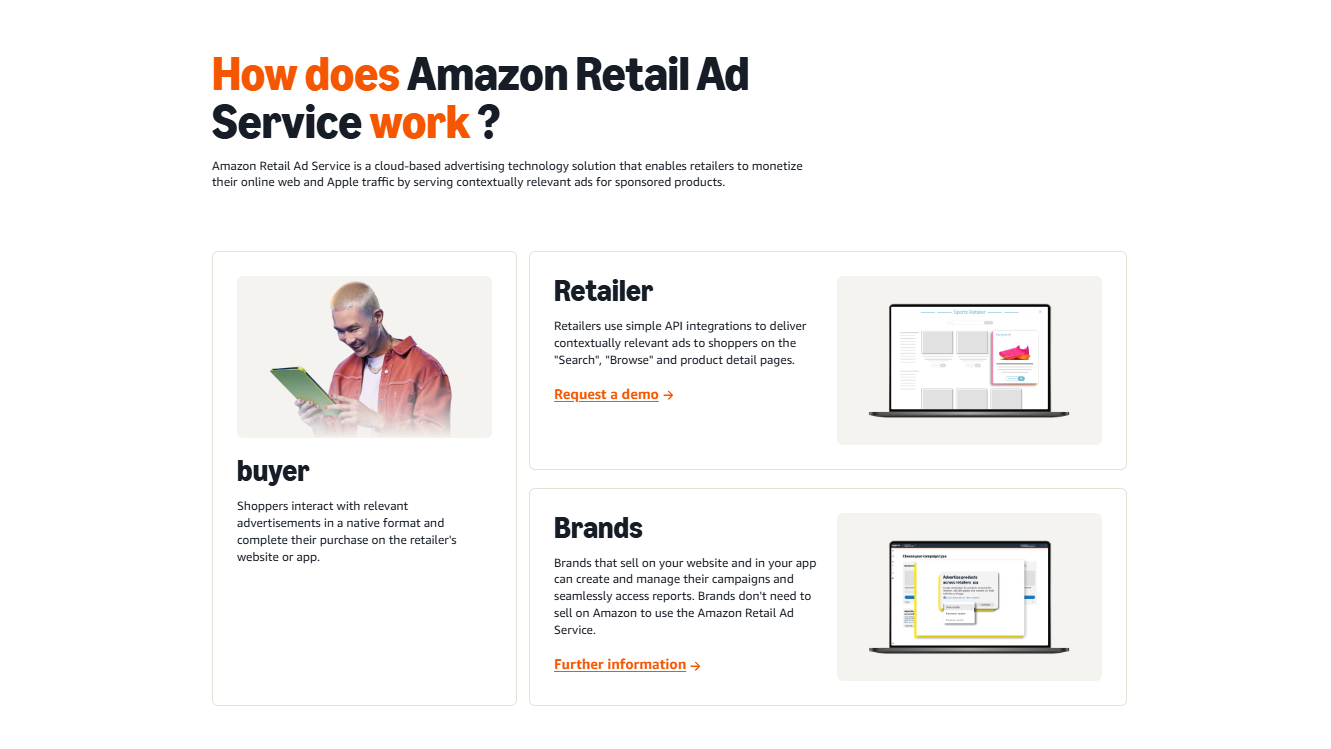
Amazon’s Retail Ad Service for brands. Image source: Watersky Digital
In European markets, the retail media landscape is significantly less mature than in the United States. It is also far less transparent. Most omni-channel retailers in Europe do not yet offer fully fledged self-service retail media platforms. Brands often hand over a budget to the retailer and receive little or no meaningful reporting in return.
This creates a significant information asymmetry. The retailer knows how the campaign performed. The brand does not. Without performance data, it is almost impossible to make a rational case for increasing, maintaining, or reducing investment on a given platform.
Measurement issues persist even where reporting does exist. Some platforms do not differentiate between advertised sales and organic sales. This makes it impossible to understand the true incremental impact of a campaign. Others use extended attribution windows. They calculate ROAS not just for the period when the campaign was live, but for several weeks afterward. This artificially inflates the apparent return.
Amazon stands out in this landscape. It offers genuinely transparent, detailed self-service reporting. Brands can see exactly how their campaigns are performing. This transparency is a significant reason why most retail media budgets are concentrated on Amazon. Better data enables optimization. Optimization drives better returns. Better returns justify further investment.
Avoiding Over-Reliance on a Single Platform
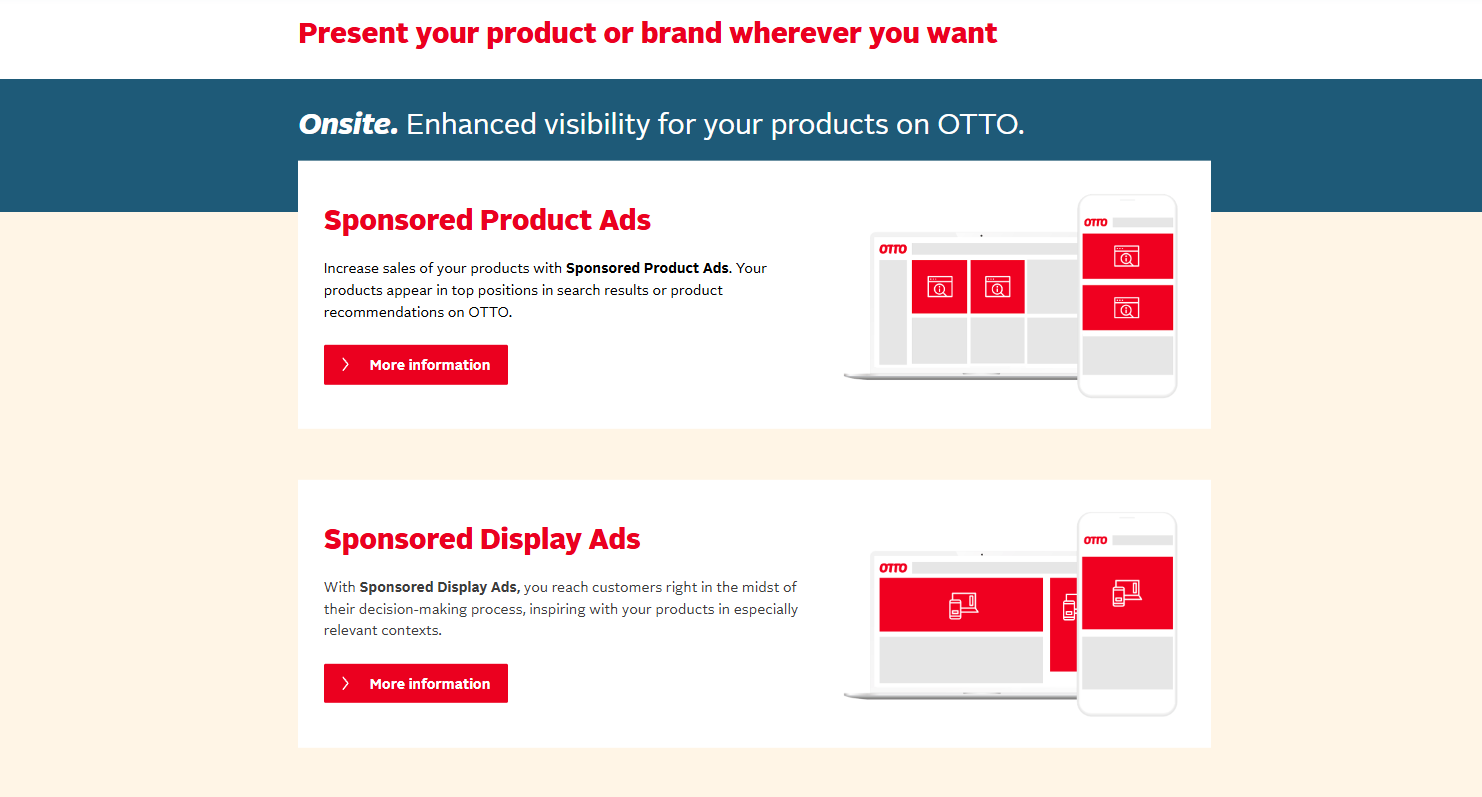
OTTO’s on-site advertising offers. Image source: Watersky Digital
Concentrating retail media spend on Amazon creates its own strategic risk. A brand allocating 90% of its budget to one platform is highly exposed. If that platform changes its fee structure, its algorithm, or its relationship with the brand, there is little fallback. It also means the brand has not built the capability or data to compete on any other platform.
The practical solution is to ring-fence a deliberate experimentation budget for other platforms. This includes Zalando for fashion and lifestyle brands, OTTO in Germany, Bol in the Netherlands and Belgium, and eBay where it fits the brand’s positioning. These experiments will not immediately match Amazon’s ROI. The platforms are less mature, and the brand has not yet built the data needed to optimize effectively. But waiting for these platforms to improve without investing in learning will never close the gap.
It is also worth challenging your agency partners. Most ecommerce agencies specialize in Amazon. They have limited experience on other platforms. If your agency cannot support retail media beyond Amazon, it may be worth bringing in additional specialist partners.
What Brands Should Do Next
- Start monitoring customer contribution, not just net sales and gross margin. This is the P&L level where retail media investment becomes visible, and it is the only level at which you can make informed decisions about how much to invest and where.
- Switch from ROAS to ROI as your primary retail media performance metric. Build the baseline data infrastructure needed to measure incremental uplift rather than total sales.
- Prioritize targeted placements when starting out. Sponsored search is the most reliable starting point for most brands. Test and evaluate before scaling to broader formats.
- Demand data transparency from every platform where you invest. If a retailer cannot provide clear reporting that separates advertised from organic sales and uses a reasonable attribution window, treat that investment with significant caution.
- Allocate deliberate experimentation budget to platforms beyond Amazon. Accept that the initial ROI will be lower as you build experience and data, and treat this as a necessary investment in platform diversification.
- Align your marketing and e-commerce teams on retail media planning. Marketing budgets spent on Amazon or other retail media platforms affect your commercial relationship with those platforms and need to be visible to your key account managers.
The Bottom Line
Retail media is not going away. Marketplaces and retailers will continue to expand their media offerings and to encourage brands to invest more. The brands that navigate this well are those that understand where retail media sits in their P&L, measure it with the right metrics, and build the capability to compete effectively across multiple platforms.
The brands that do not get this right will find themselves with growing e-commerce channels that look impressive at the top line and are quietly unprofitable underneath.
FAQ’s
What is retail media and how is it different from traditional advertising?
Retail media is any media bought from a retailer, marketplace, or ecommerce platform. This includes sponsored listings, search ads, display banners, and off-platform placements like Amazon Prime Video. Unlike traditional advertising, it is purchased directly from the platform where your products are sold. This ties it to your commercial relationship with that platform and places it in a different part of your P&L.
Why is retail media a hidden profitability risk for brands?
Retail media only appears at the customer contribution level of the P&L, below gross margin. Most brands do not monitor this metric. This means costs can accumulate without showing up in the numbers leadership tracks. e-commerce channels can look healthy at the top line while being unprofitable underneath.
Why is ROAS not a sufficient metric for evaluating retail media performance?
ROAS measures total sales against ad spend. It does not separate organic sales from campaign-driven ones. It also does not account for simultaneous discounting or tell you whether sales were actually profitable. ROI is the more meaningful metric. It measures the true incremental uplift against the full cost of a campaign.
How should brands approach retail media investment on platforms beyond Amazon?
Set aside a deliberate experimentation budget for platforms like Zalando, OTTO, or Bol. The initial ROI will be lower as you build data and experience. But waiting for these platforms to improve on their own will never close the gap. Also challenge your agency partners. Most specialize exclusively in Amazon.
What should brands demand from retail media platforms in terms of reporting?
Ask for reporting that separates advertised sales from organic sales. Make sure the attribution window is clearly defined and reasonable. You should also have enough data to calculate incremental ROI. If a platform cannot provide this, you are investing blind.
Want to know how your brand currently performs in AI search optimization? Reach out to us to discuss an AI Visibility Audit!
About the Author
This article was written by Mary Sugui, a digital marketing analyst with expertise in e-commerce, digital strategy, and performance marketing.
Her work focuses on analysing how emerging technologies such as AI, automation, and data-driven systems are reshaping online retail and customer behaviour. She specializes in understanding evolving digital commerce ecosystems, with a strong interest in how brands can adapt to changing consumer expectations and build scalable, future-ready e-commerce strategies.