Why you need to find Amazon Competitors for Your Business & How to do it Reliably
If you believe Amazon competitors may not matter as much as the retail giant itself, you are not alone. There’s no mention of eCommerce without associating it with Amazon in most markets. For many manufacturers and brands, Amazon represents an incredible opportunity to increase online sales. However, manufacturers falsely believe that Amazon’s competitors may not matter as much. In the growing landscape, businesses need to learn who Amazon’s biggest competitors are. They also need to know how to leverage these competitors for long-term eCommerce success.
Amazon Competitors in eCommerce – Key Takeaways
- Amazon’s Dominance in Europe – Why It Is Both an Opportunity and a Risk: Amazon holds 30–50% market share in key European markets, making it a critical sales channel – but over-relying on it squeezes margins, limits flexibility, and leaves you vulnerable to its changing business model.
- Why Brands Need Strategic Amazon Alternatives: Focusing all resources on Amazon means its biggest competitors are underserved. Retailers like Zalando, Douglas, and Flaconi can deliver comparable results in categories like beauty – and give you leverage in trade term negotiations.
- How to Find the Right Amazon Competitors for Your Category: Use a data-driven approach – look at total traffic, category net sales, and retailer capabilities like search, product showcase, and conversion to identify which platforms are actually worth investing in.
- How a Diversified Retail Strategy Reduces Risk and Drives Growth: Building a balanced portfolio of retail partners reduces dependency on Amazon, creates negotiating power, and allows you to allocate resources where they have the most impact.
1. The Undeniable Importance of Amazon
Amazon’s competitive dominance in the European eCommerce landscape is undeniable. With a significant market share in key countries, Amazon serves as a critical sales channel. Typically, in markets such as Germany, the UK, and France, for many product categories, the retailer has between 30 and 50% market share.
Why Amazon is a must-have from the manufacturer’s perspective

Data from 2023 showing Europe’s biggest online stores by Ecommerce Net Sales. Source: ECDB
For many manufacturers, Amazon isn’t just a competitive option with significant market share; it’s frequently their single largest eCommerce account. This also means that Amazon demands considerable attention and resource allocation within your eCom setup.
With many of our clients, we see that they have allocated 80% of their resources to the platform as it generates a very high turnover for them. This leaves only 20% of financial as well as team resources for Amazon competitors that they already operate on. However, the market reality is that Amazon accounts for ~40% market share. This means the biggest competitors of Amazon are underserved and therefore not properly leveraged for their potential!
2. The Challenges of a Singular Focus: Why you need to identify Amazon’s Competitors
While Amazon’s market power is undeniable, you will also know the increasing challenges of working with the retail giant.
- Amazon operates on a highly transactional model. This often leads to difficult and inflexible trade term negotiations that can squeeze profit margins.
- Vendor managers are rotated often, making it difficult for you to establish long-term relationships with the platform.
- Amazon regularly matches prices downwards, triggering price spirals for brands as well as competing retailers.
- Moreover, Amazon has been strategically deprioritizing its 1P (first-party vendor) model in many categories. The retailer has been shifting focus towards 3P (third-party seller) as it’s often more profitable for them.
This strategic shift by Amazon leaves many brands in a precarious position. Brands are facing pressure to adapt to a changing business model or accept less favorable terms for their existing relationships.
All of this shows us one thing.
Relying on Amazon as your primary eCommerce driver, no matter how large their market share is inherently risky and limits your strategic flexibility.
3. Evolving in eCommerce Maturity: Beyond Net Sales
For you to achieve true eCommerce maturity, it’s critical to move beyond tracking net sales on Amazon as the sole measure of success. You may have already developed more complex eCommerce KPI models within your organization. However, it is still worth it to ask yourself if you’re measuring the true picture.
While sales volume is important, the reality of working with Amazon often involves significant retail media investments. These investments can eat into profitability more than you may have realized. Amazon expects high advertising spend to maintain visibility and secure prime placements, transforming what appears to be strong top-line revenue into a less attractive bottom line.
A mature eCommerce strategy recognizes that sustainable growth requires a more nuanced approach. One that focuses on overall channel profitability, diversified reach, and a holistic view of the competitive landscape. If you apply normal controlling standards to Amazon, you quickly realize that it’s much less attractive as a retail channel.
4. What Can Organizations Do to Counter Amazon’s Dominance?
Upon realizing that the bottom line is getting squeezed on Amazon, organizations may consider drastic measures such as dropping Amazon entirely. While tempting for some, this is often not feasible for most brands due to Amazon’s immense market share and consumer mindshare. Abandoning the platform could mean sacrificing significant sales volume and brand visibility. This leaves manufacturers with the following options:
- Transition Fully to 3P (Third-Party Seller Model): This offers greater control over pricing, inventory, and branding, potentially leading to higher profit margins. However, it demands heavy internal investments in logistics, customer service, and platform management, requiring a significant shift in operational capabilities.
- Implement a Hybrid (1P + 3P) Model: This sustainable approach combines the benefits of both. You can leverage 1P for core products and strategic categories while using 3P for greater control over specific items or to test new products. While potentially the most resilient, it involves substantial upfront costs. Plus, internal complexities in managing two distinct models, and a sophisticated understanding of Amazon’s intricate ecosystem.

- Find Strategic Counterweights for Amazon: This is often the most effective strategy for long-term sustainable growth and negotiating power. By identifying and nurturing relationships with other strong, relevant online retailers, brands can reduce their over-reliance on Amazon. These “counterweights” provide alternative sales channels and diversify revenue streams. Further, they also act as leverage in discussions with Amazon, demonstrating that a brand has other viable avenues for growth. This strategy fosters a healthier, more balanced eCommerce portfolio.
For instance, let’s look from the perspective of a beauty brand in Germany. Amazon may look like the only player that can offer mass reach compared to more niche beauty retailers like Flaconi. However, data would show that an unexpected retailer like Zalando can offer both reach as well as space on their digital shelf for beauty products.
5. How to Find Amazon’s Biggest Competitors
We’ve already established that the best and most sustainable solution is to have strategic counterweights. In other words, find the biggest, most viable Amazon competitors in your category. Focusing your eCommerce strategy on a diverse portfolio of retail partners will reduce overreliance on Amazon, as well as give you leverage to have better trade terms.
Identifying effective strategic counterweights requires more than just anecdotal evidence or gut feel. It demands a data-driven approach to truly pinpoint Amazon’s biggest competitors in your specific product category and target markets
Start by identifying which retailers have the biggest footprint in your market:
- Total Traffic – How many visitors do they get per month or year?
- Relevant Traffic – Filtered traffic to show what ratio of traffic is relevant for your sector.
- Category Net Sales – How profitable is the retailer in your category?
Combine this with how capable the retailer is in converting visitors into shoppers
- Search & Navigation – How easily can users discover your products?
- Product Showcase – How effectively can you showcase your portfolio on product, category, and brand pages?
- Conversion & Retention – How effective is the purchase funnel, and what does the retailer do to keep shoppers coming back?
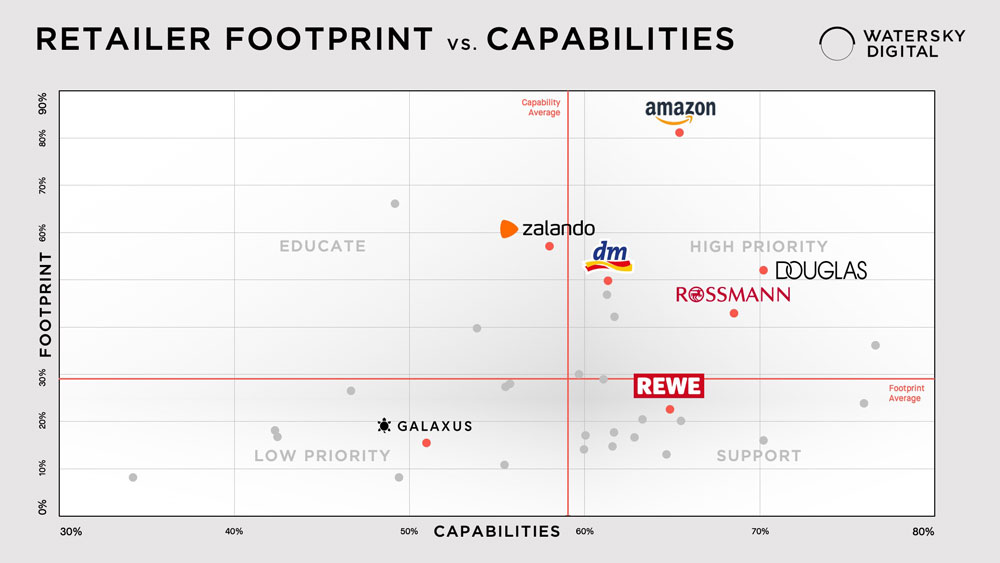
This combined view will give you a clear picture of a retailer’s attractiveness for your sector. Interested in this exercise? Learn more about eCommerce Segmentations.
The Benefit of Identifying Strategic Amazon Competitors
Doing this allows you to clearly find gaps in your eCommerce strategy in the following ways:
- Are you missing top retailers?
- Are you negotiating with Amazon and other retail partners being informed of their market power in your sector?
- Are you allocating internal resources appropriately among retailers?
- Lastly, are your own net sales proportionate to the market power of your retail partners?
You can investigate your strategy and reallocate resources in an informed way. This will also allow you to predict net sales from other retail partners based on data. Thus, by prioritizing Amazon’s biggest competitors, you can make your overall strategy robust and able to deliver sustained eCommerce growth.
Let’s use the example of the beauty industry, where you may have the following scenario: Amazon could account for 40% market share in your country and category. However, it could represent 70% of your eCommerce turnover. You may have in turn allocated 80% of your resources to the platform. Consequently, you have only the remaining 20% to dedicate to Amazon’s competitors that you already operate on.
Doing this exercise could help you realize that Douglas, Flaconi, and Zalando are all able to deliver competing results with Amazon. You could then reallocate resources to these important retailers to ensure you can support growth on them.
6. Conclusion: You Need Data
This is where specialized analytics and insights become invaluable. Watersky Digital’s eCommerce audit services are specifically designed for this purpose:
- eCommerce Landscape Segmentation: Our methodology uses advanced traffic data to identify the actual dominant online retailers in any given market for your specific category.
This goes beyond general market share reports to pinpoint who consumers are really visiting and purchasing from when they’re not on Amazon. The results provide a precise understanding of the competitive hierarchy and help you discover new, relevant retail partners.
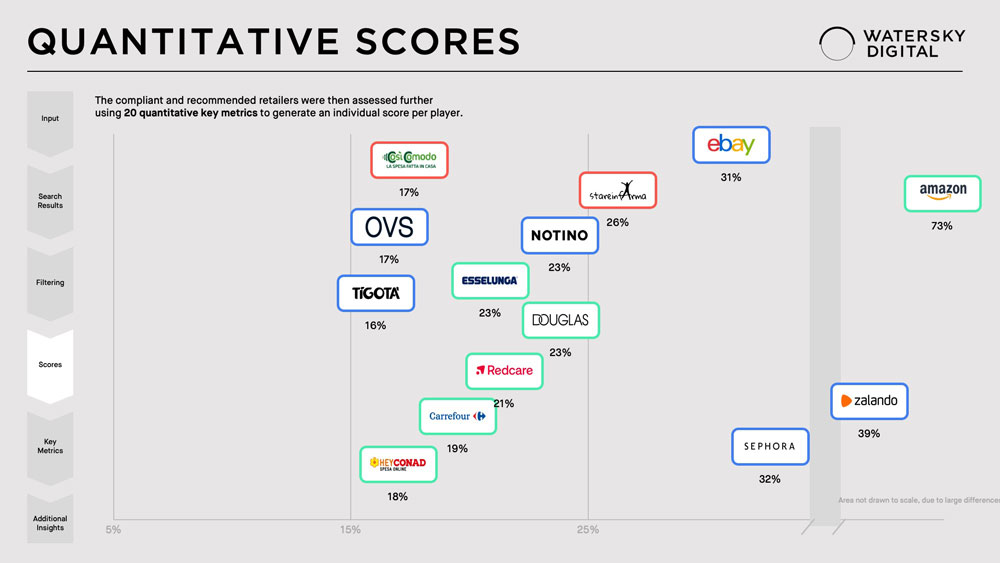
- Retailer Benchmarking: Once your Amazon competitors are identified, our benchmarking audit provides an in-depth comparison. You can measure their size, capabilities, and overall digital strength. We evaluate numerous factors, from website user experience and SEO performance to social media presence and logistical capabilities.
This allows you to quantitatively assess which retailers truly have the reach and operational maturity to serve as effective strategic alternatives to Amazon. You can then understand where to invest your marketing budget for maximum impact based on a retailer’s specific strengths. E.g., if a competitor of Amazon excels in social media, it might be a prime target for your social ad spend.
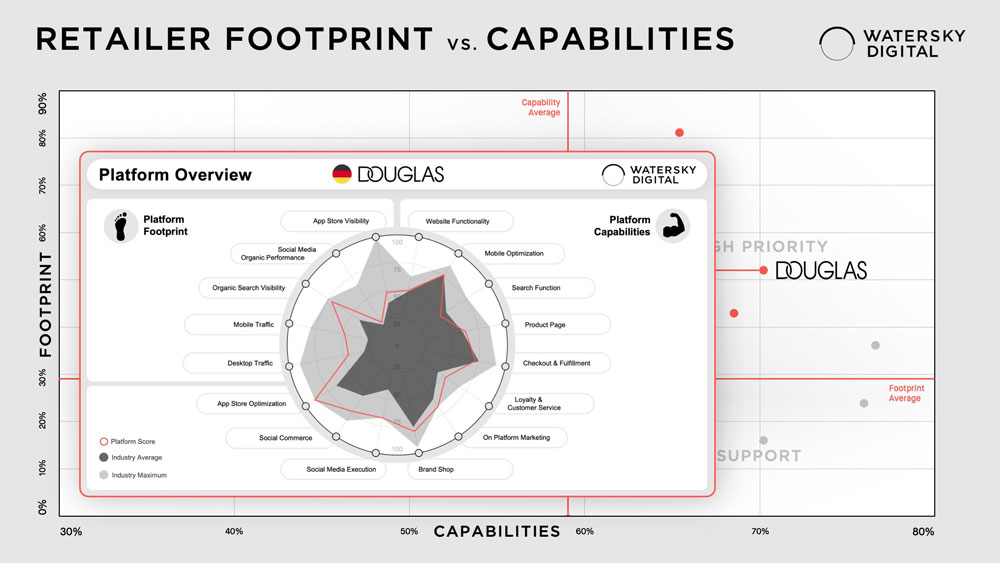
By leveraging these insights, manufacturers can move beyond reactive responses to Amazon’s demands and build a diversified, resilient, and profitable eCommerce ecosystem.
How to Get Started
Ready to start your data-driven eCommerce strategy and identify the biggest Amazon competitors in your sector? Read more about our methodology and kick off your retailer segmentation now.
Want to benchmark your own retailers against Amazon?
Schedule a Free, No-Obligation Call to Learn More!
FAQ: Amazon Competitors in European e-Commerce
Why should brands not rely solely on Amazon for e-Commerce sales?
Who are the biggest Amazon competitors in Europe?
How do you identify the right Amazon alternatives for your category?
What is the difference between Amazon 1P and 3P selling?
How can Amazon competitors improve your negotiating position?
How are smaller platforms competing with Amazon?
This article was written by Diamanta Hykaj and Alexandra Akaoui, digital marketing analysts with strong backgrounds in e-Commerce, digital marketing, beauty, and retail strategy.
Their work focuses on analysing competitive digital landscapes, e-commerce market shifts, consumer behaviour, and emerging retail technologies. With expertise in AI-driven marketing, omnichannel commerce, and performance analytics, they help brands understand how major players like Amazon and its competitors are shaping the future of global online retail.