eCommerce Trends 2025 – Looking into AI & Beyond

The eCommerce landscape is always changing. Since 2020’s eCommerce boom, there have been new platforms, new online-only brands, new shopping features, and more conveniences being offered to shoppers. Online shopping shows no signs of slowing down this year which brings us to our overview of eCommerce Trends 2025. Let’s look at the top developments that you need to be aware of and more importantly, the top actions you will need to take in order to drive visibility and conversion!
eCommerce Trends 2025 – Key Takeaways
- AI in eCommerce 2025 – From Hype to Practical Use: AI is moving from buzzword to real use – focus on better product content, smarter recommendations, and connecting your inventory data so AI tools can work with it.
- Quick Commerce and Social Commerce Growth in Europe: Fast delivery is making a comeback, and TikTok Shop is expanding across Europe. Identify which products fit quick commerce and support retail partners with social-ready content.
- European Marketplace Strategy for Brands in 2025: Over 80% of European eCommerce traffic goes through marketplaces. Use a mix of established platforms like Amazon and newer players – but pick retailers that match your brand values.
- Cross-Border eCommerce in Europe – Opportunities and Risks: Selling across borders is getting easier, but pricing conflicts and local regulations are real risks. Set clear rules across your markets early and choose retail partners with broad European coverage.
1. 2025 – The Year of Practical AI Implementation
No eCommerce trends article in 2025 can exclude AI as a topic. However, this year we move from the theoretical buzz of AI to its practical implementation on eCommerce.
How will AI affect eCommerce?
AI will touch several aspects of eCommerce including content production through generative AI, enhanced product recommendations, and better inventory management between retailers and manufacturers.
But let’s focus on what is realistic for 2025 and what is more likely to come in the years to follow. This year AI’s impact is focused on product discovery and inventory optimization. Advanced features like hyper-personalization through AI assistants and increased automation in content creation and marketing are currently still not reliable enough (or very labour intense) and are likely to only reach mainstream adoption in 2026 and beyond. Further, in 2027 AI will start to leverage AR/VR to create fully immersive experiences blurring the lines between online and offline shopping.

Amazon Rufus – an already existing AI shopping assistant foreshadows what trends will be seen in 2025. Source: aboutamazon.com
Here’s everything AI-related that you
need to action in 2025
Enhanced Product Information and Discovery: AI-powered product descriptions, image recognition for visual search, and intelligent product tagging become crucial. This makes products more discoverable on platforms and improves SEO.
Personalized Recommendations and Merchandising: AI-driven recommendation engines will move beyond basic collaborative filtering to offer highly personalized product suggestions based on individual customer behavior, browsing history, and even contextual factors. This drives upselling and cross-selling opportunities.
Your Actions:
Focus on creating content in a way that LLM (Large Language Models) can read and easily catalog your portfolio. How do you do this?
- Structure your content properly and consistently. Don’t just create optimized content for your hero products. Rather create structured content – always write titles including brand, model, product category, size, material, etc. Always structure secondary images to showcase the product, and the packaging, show the product in use, show social proof, etc.
- Similarly, use long tail keywords and answer frequently asked questions to make it easier for users as well as LLMs to read.
- You can test AI-powered content generation. However, expect to review and rework the output.
- Prepare your data! To be ready for AI-analytics, your data needs to be consistently structured and available for a long time horizon. This year is perfect to prepare this, and gather the experience necessary to manage (and steer) AI analytics assistants.
- Use clear and concise language – avoid technical jargon and complex terminology as LLMs serve users based on questions posed in conversational language.
Demand Forecasting and Inventory Optimization: AI algorithms analyze historical sales data, market trends, and even social media sentiment to predict demand more accurately. This optimizes inventory levels, reduces stockouts, and minimizes storage costs.
Your Actions:
For your 3rd party retailer business, it is best to help connect your inventory management systems to theirs.
- Start by providing accurate and timely product data to your retail partners – product specifications, any historical sales data, product lifecycle information, and planned marketing activities (outside the retail platform). This data can be fed into their AI engines to predict demand better and avoid out-of-stock situations.
- Connect inventory systems through API where possible so your data can flow directly into their tracking and management infrastructure.
- For smaller retail partners, you can also establish yourself as a strategic partner by jointly developing inventory management technology or jointly investing in existing tools or services.
2. Quick Commerce & Social Commerce Make a Comeback
Quick Commerce or qCom is not new. In fact, 2023 saw a surge in new entrants in Europe including Gorillas and Flink. 2024 was the year that Getir (including Gorillas) shut down their business outside of Turkey.
Despite these setbacks, qCom is predicted to be a hot topic among other eCommerce trends in 2025. Furthermore, it’s forecasted to grow CAGR of 7% in Europe, this year.
How will qCom manage to grow in 2025?
In 2024, qCom players in Europe focused on rapid expansion and multi-city coverage. This ate into their profitability by adding high overheads.
In 2025, you can expect that qCom players existing and new will take a more strategic approach to growth. They will focus on per-unit profitability so they don’t end up with high delivery costs and low average basket values.
The re-emergence of qCom has implications for customer basket sizes, pricing as well as last-mile delivery.
Your Actions:
In 2025, remember that qCom is still gaining its footing after facing challenges. At this stage, it is best for you to keep an eye on which players emerge in your markets and develop a consistent investment approach for them (e.g. Treat them as clients or media channels).
It is also beneficial to identify products in your portfolio that fit a qCom delivery cycle. Where possible, research on how to price for qCom retail partners can also help you make better-informed trade term agreements.
2025 – The Year of Social Commerce Expansion in Europe
Social Commerce or shopping enabled on social media platforms is certainly not a new concept. However, it still features among top 2025 eCommerce trends. Social Commerce’s rollout and success in Europe have been mixed in the last 2-3 years. Compared to the adaption rates in China and Southeast Asia, European consumers have been sluggish to adapt to it.
In fact, TikTok shop was meant to be rolled out through Europe as early as 2022 and was then deprioritized. On Instagram, even advanced industries such as beauty went as far as using shoppable posts. However, the use of Instagram shop or allowing users to checkout directly on the platform was still limited.
This year, TikTok plans to roll out TikTok Shop in Europe starting with markets such as Spain and Ireland.
In addition, influencer marketing continues to be a major eCommerce trend in the social sphere. Ad spend on influencers is predicted to grow at an almost 8% CAGR.
How will brands leverage influencers in 2025?
AI tools can help identify the right micro and nano influencers that better fit with the positioning and messaging of brands. Influencers will lend authenticity to brands whose users grow ever more skeptical of traditional advertising.
One watch out:
Influencer marketing still has not had a very concrete sense of ROI delivery. In 2025, influencers and their representatives such as agencies will need to clearly deliver KPIs based on the marketing goals of the brands that hire them.
Your Actions:
In Europe, for brands that don’t have their own DTC eCommerce shops, it may not be necessary to directly sell through social media or link shoppable posts to product pages (PDPs) on your website.
To start with, work with your retail partners to support their social commerce initiatives. You can do this by:
- Providing social-ready content to retail partners e.g., vertical videos
- Link any shoppable posts on your social media accounts directly to your 3rd party retailer PDPs
- Be clear that any influencers should also link products back to pages where the conversion loop can be completed in as few steps as possible
3. Marketplace Dominance Continues with New Entrants Challenging Big Names
In the largest European Markets, the eCommerce landscape has trended towards Marketplace growth. Already as of 2023, over 80% of all web traffic in Europe went to marketplaces.
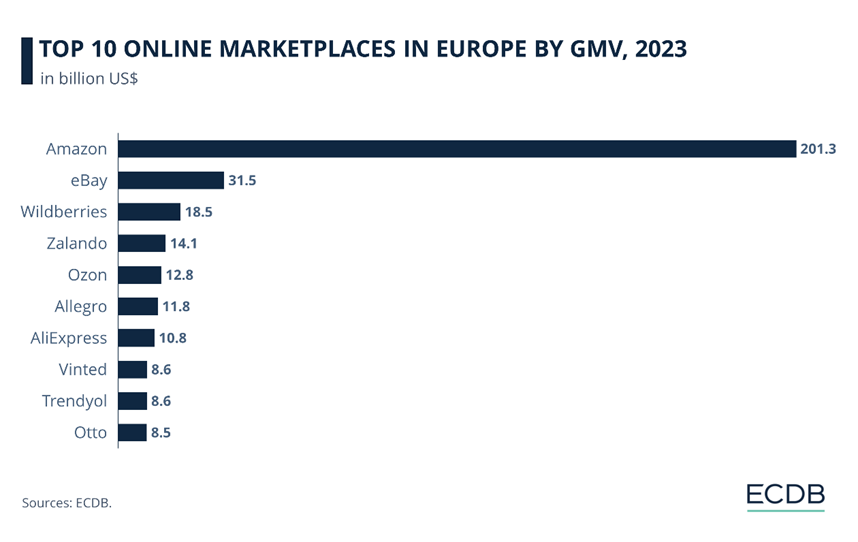
Data from 2023 showing Europe’s biggest marketplaces. Source: ECDB
This trend has continued into 2024 and will continue this year. While Amazon, eBay and Allegro maintain their stronghold within Europe, the picture will look quite different from what we’ve seen since 2023.
New Entrants force eCom market to evolve
If global eCommerce trends are to serve as a predictor for Europe in 2025, new entrants Shein and Temu are going to be disruptors.
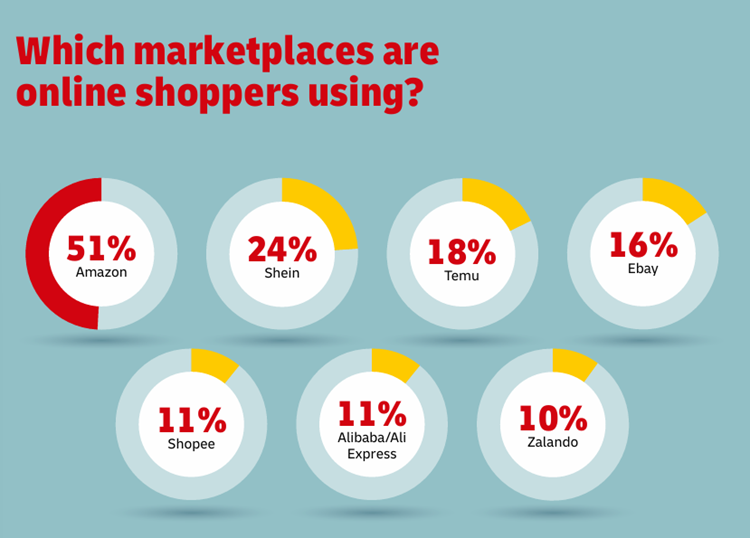
Biggest Marketplaces globally by marketshare. Source: DHL
In 2024, Shein was already predicted to generate higher revenue than European giants Zara and Zalando.
How do Shein & Temu generate repeat purchases?
These Chinese retail giants offer ultra-low prices on product selections that range from fashion to home goods. Their agile supply chains (direct from factory) and aggressive marketing and price-cutting strategies have helped them gain ground very quickly.
Further, they rely on a gamified approach to keep consumers hooked. Gamification is built into these platforms through tactics such as:
- Daily deals
- Spin wheel discounts
- Progress bars for purchases
- Referral programs and discounts
What this means for you
You need to have a diversified retail strategy – including established giants such as Amazon, eBay, Allegro, etc. along with new and emerging players.
To identify the best retailers for your brand and product category, it is best to apply a data-driven approach. This can help you ensure that you cover your ground by having enough counterweights to dominant players as well as knowing the challenge areas these retailers face so you can establish better trade terms for your brand.
Your Action:
Apply a retailer segmentation approach to identify the best players in each of your markets within Europe. Retailers who may work well for one industry (e.g. Bol.be for fashion) may not always be the best for for another (e.g. Amazon.be leads in electronics).
Therefore, identifying the right online platforms for your category is key.
Furthermore, you need to bear your brand values in mind. Temu and Shein may be good for the bottom line, but they are not suited for premium or sustainably produced products.
Sustainable and Ethical eCommerce
Sustainability and Ethical eCommerce will not just be eCommerce trends in 2025. They will receive more mainstream attention as price-cutting and environmentally questionable platforms continue to grow within the European Economic Area.
For brands with more of a conscience it will be better to align with platforms that reflect their brand values. This perspective will also help justify differences in prices between value-driven marketplaces and more exclusive retailers.
The EU will continue to regulate towards sustainability and a circular economy model to reduce waste. Similarly, like the US you can expect that Europe will levy higher import fees and enact more stringent labor laws to safeguard European standards.
4. Cross Border trade brings new opportunities and challenges
Online shopping across borders will become smoother with improved logistics and payment solutions, opening up new markets for businesses. This further increases product variety for consumers. This is a topic that could also bring challenges to brands among other eCommerce trends in 2025.
Hence, aligning trade terms and pricing policy across countries & (e)retail channels is more important than ever. Start by creating a tier system for international clients based on factors like revenue potential, profitability, and category importance. Next, derive investment principles that apply consistently across all countries.
Also, explore regulatory opportunities to orchestrate the distribution (e.g. VBER).
What considerations are there for cross-border eCommerce in Europe?
- Harmonization, but Not Uniformity: While the EU has made strides in harmonizing regulations, differences still exist between member states regarding product standards, labeling, and consumer protection.
- The Rise of Direct-to-Consumer (D2C) Cross-Border: Manufacturers increasingly sell directly to consumers across borders through their websites, bypassing traditional distributors and retailers. This offers greater control over branding and customer relationships.
- Sustainability as a Key Differentiator: European consumers are increasingly environmentally conscious. Manufacturers who prioritize sustainable practices and offer eco-friendly products will have a competitive advantage in the cross-border market.
Which eCommerce Platforms in Europe offer the best cross-border coverage?
The landscape in 2025 will be a mix of established players and new disruptors. Here are the top 5 players that offer cross-border coverage within Europe:
- Amazon – serving Germany, France, Spain, Italy, the UK and more
- Zalando – serving Western Europe, the Nordics, Southern as well as Eastern Europe
- Ali Express – also serving Germany, France, Spain, Italy, the UK, etc.
- Allegro – serving Poland, Czech Republic, Slovakia, Hungary, Croatia, Slovenia
- Bol.com – serving the Benelux region
What Challenges will cross-border trade bring in 2025?
- Logistics and Fulfillment: This can prove to be a challenge when you first expand into markets where you don’t have an active presence.
- Price Wars and Cannibalization: A common problem for corporates where profit centers can fight over territory and markets with price benefits can flood premium markets with their goods.
- Varying Regulations and Compliance: The EU is still working towards uniform regulations, and this can have implications for legal expenses for brands looking to expand.
- Language Barriers and Customer Service: This is common when serving a market as dynamic and complex as Europe. Not only does packaging need the right language(s) but also customer service needs to be offered in a way that customers in new markets can still reach brands.
- Currency Exchange and Payment Processing: This is one of the least complex challenges within the EU but could still pose problems as each country has preferred payment methods.
Your Actions:
Establish clear ground rules within your organization on which territories should be handled by which profit centers. The clearer these rules are at the beginning, the less you are likely to face issues of price wars and cannibalization within EU markets.
Choose retail partners that cover the most ground for markets that you’re active in or would like to expand to.
Actions for those who prefer to go DTC:
Partner with experienced international logistics providers who offer end-to-end solutions, including customs clearance, warehousing, and last-mile delivery. Consider using fulfillment-by-Amazon (FBA) or similar services offered by other platforms. Establish clear return policies and procedures for each market. Partner with local return centers or logistics providers to handle returns efficiently and cost-effectively.
Invest in legal and regulatory expertise to ensure compliance with product safety standards, labeling requirements, and consumer protection laws in each target market. Work with local consultants if needed. Offer multilingual customer support through phone, email, and chat. Translate product descriptions and website content into the languages of your target markets.
Offer multiple payment options, including local payment methods popular in each target market. Use payment gateways that handle currency conversion and comply with local regulations.
What’s Next?
In 2025, a lot of eCommerce success will depend on being present on the right retailers. Not sure where to get started? Talk to us!
Interested in empowering your team and preparing them for a successful eCom year? Talk to us via moin@watersky.digital about how we can help!
Do you want to stay up to date in Digital Marketing?
eCommerce Trends 2025: Questions & Answers
What are the Key e-Commerce Trends for 2025?
How is AI shaping e-Commerce in 2025?
What is Hyper-Personalisation in e-Commerce?
How is Social Commerce changing online shopping?
Which Marketplaces should Brands focus on in Europe?
What role does customer experience play in e-Commerce success?
This article was written by Sharanya Venkatesh, a digital marketing manager with an MBA from Oxford and strong expertise in SEO, content marketing, e-commerce, and analytics.
With a background in media and marketing, Sharanya specialises in content creation, optimisation across different channels and audiences, and performance measurement. Her work focuses on helping brands improve visibility, engagement, and conversion through data-driven content strategies.
Having lived in four countries, she brings a global perspective to her work and is passionate about understanding local cultures and how they influence digital behaviour and content consumption.