AI Use cases in e-Commerce: How AI is transforming online shopping

The e-Commerce industry is undergoing a rapid transformation. Artificial Intelligence (AI) is greatly changing user behavior. Various AI use cases in eCommerce, such as personalized shopping, chatbots, and AI-generated content, are no longer nice-to-have. It is now essential for brands that want to stay ahead in a rapidly evolving market. Let’s break down its core applications and see how businesses can use AI for long-term success.
AI Use Cases – What You Will Learn
AI is no longer optional in eCommerce. From content creation to pricing, brands that use AI effectively can reduce costs, meet rising customer expectations, and stay ahead of the competition. This article breaks down the five most practical AI use cases in eCommerce and how to apply them.
Key Takeaways – AI Use Cases in e-Commerce
- AI-Generated Content – Produce More, Faster and at Lower Cost:
Generative AI can create product copy, campaign images, and localized content in a fraction of the time. Always have an experienced team member validate the output before it goes live. - Chatbots and Conversational AI – 24/7 Support Without Replacing Your Team:
AI chatbots handle FAQs, order tracking, and multilingual support around the clock. Use them to reduce costs on routine tasks – but keep humans available for complex issues. - AI Visual Discovery – Let Customers Search With Images:
Visual search tools like ASOS Style Match let shoppers find products by uploading a photo. Optimize product images with high resolution, multiple angles, and strong meta tags to benefit from this trend. - Hyper Personalization – Recommendations That Feel Like a Personal Shopper:
AI-powered recommendation engines can boost revenue by 10-15% by tailoring suggestions to individual browsing and purchase behavior in real time. - Dynamic Pricing – React to the Market Automatically:
AI adjusts prices based on demand, stock levels, and competitor moves. Set clear floor and ceiling price rules and check local regulations before rolling out any dynamic pricing system.
Why AI Matters in Ecommerce Today
AI adoption is gaining popularity across eCommerce platforms due to the following:
- To the Customer – Changing behavior and expectations
Customers have higher expectations. Nowadays, they want speed, accuracy, and personalization.
- To the Retailer – Efficiencies to meet expectations
eCommerce has long since generated massive volumes of data from clicks, carts, and customer behaviors, and AI can now analyze this data and spot actionable insights, automating decision-making.
- To Brands – Ability to compete
Brands must find ways to be more visible, fulfill customer expectations in a way that they can differentiate and future-proof themselves.
Because AI can automate complicated tasks, it allows businesses to optimize every function, making it possible for them to scale up and compete. Around 80% of global eCommerce companies are also considering using AI in 2024 for different functions.
Key AI Use Cases in Ecommerce
1. AI-Generated Content
Producing useful marketing content for customers that stands out is a challenge, often due to limited resources and tight deadlines. Generative AI tools can solve this by producing images for your website and campaigns, writing engaging copy, and producing localized content. This can reduce operational costs and smoothen workflows within verticals.
European fashion retailer Zalando is now using AI to create 3D images of models wearing their featured brands. According to reports, this cuts down their month-long production schedules to a matter of days, enabling them to publish content on time and in line with social media trends.
How you can apply this:
- Explore using generative AI for images and copies that are the most repetitive and time-consuming (e.g. Product Pages, Emails).
- Train and test content using brand guidelines, to ensure that content being produced fits your approved tone of voice. AI models can also optimize content based on customer feedback, ensuring that it reflects real-time customer feedback, allowing you to test A/B campaigns.
- Integrate AI tools into your Content Management Systems (CMS) to optimize batch processing for seasonal sales and seamless publishing. AI can also help you localize your content by creating region-specific copies and images, ready for instant deployment across channels.
Key Tip: Make sure experienced team members can validate the content created by Gen AI. While tools are improving every day, they are still not perfect.
2. Chatbots and Conversational AI
Conversational AI use cases in eCommerce in the form of chatbots and virtual assistants helps crucial functions such as customer service. AI enables 24/7 personalized support and can handle basic functions from answering frequently asked questions (FAQs) to complex shopping tasks like multilingual support, order tracking, and even personal shopping. This reduces waiting times for customers, leading to higher customer satisfaction.
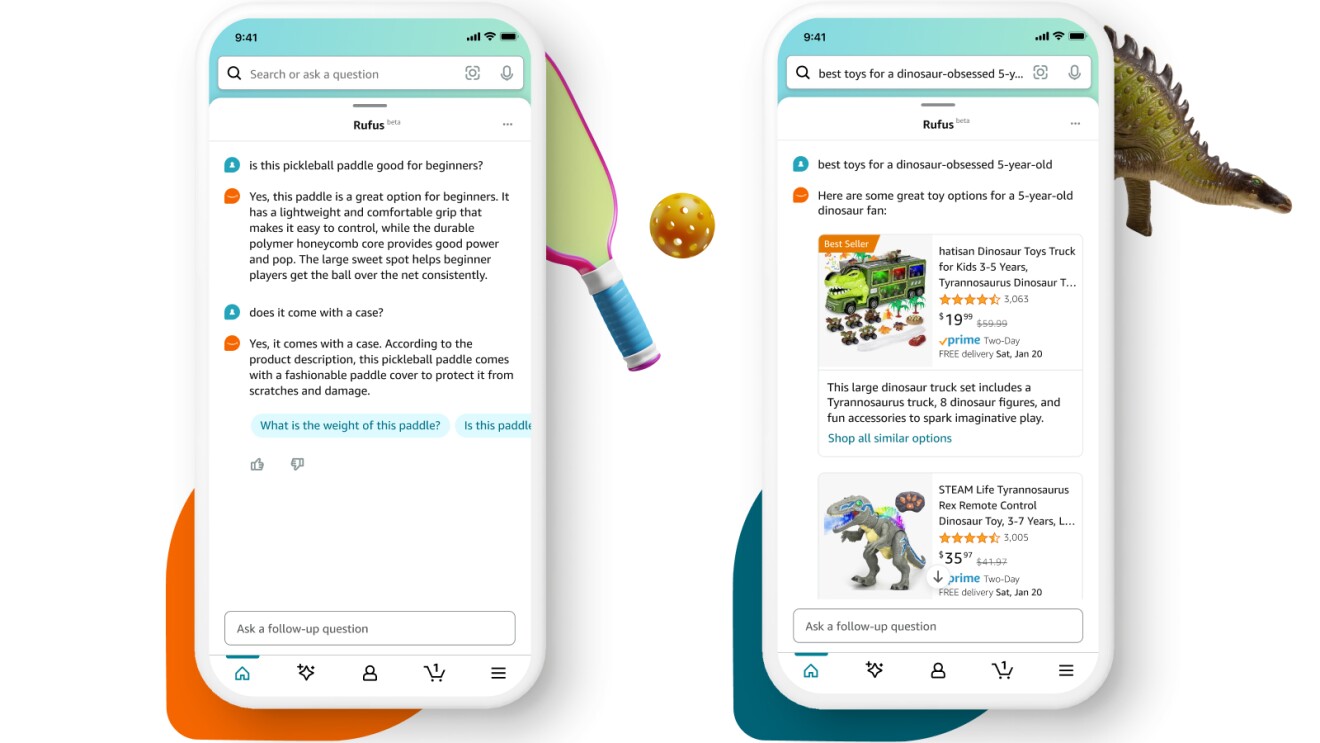
A sample conversation on Amazon Rufus. Source: aboutamazon.com
Retail giant Amazon currently applies this with Rufus AI. It is integrated with its product catalog, community discussions, reviews, and general information available online to answer questions. Buyers can search for products by occasion or purpose, ask specific questions about a product, and get recommendations based on their needs.
How you can apply this:
- Identify common FAQ’s and your customer journey – Prioritize high-volume, repetitive tasks and queries from your customers. Mapping out your customer journey will help you identify which processes will benefit the most from AI.
- Choose and explore a platform – Many AI tools, such as Shopify and Zendesk, offer chatbots customized to your business. Integrating this with your back end will also make sure that important data such as order tracking, returns, and customer history is seamless.
- Let your customers know – Communicate about this availability with customers across your channels as an added convenience to them. You can also use analytics from conversations to help improve your chatbot flows.
Key Tip: Do not replace human customer service reps completely. Leveraging AI here can reduce cost and solve simple problems. However, a system needs to be in place for more complex problem solving, so that customers don’t reach a dead end with their issues.
3. AI Visual Discovery
Visual search is gaining traction, where AI helps customers identify product details like color, pattern, and shape, ensuring accurate matches. This approach removes the friction of text-based search, making the product discovery process quicker. Shopping for personal care products, fashion, and even home decor is made easier, leading to higher customer engagement, improved conversion rates, and reduced returns.

ASOS’ Style Match Feature. Source: ASOS.com
ASOS’ Style Match allows users to search its product catalog through uploading a photo. Users can also sort search results by different filters like price, color, and fabric, to suit their taste. ASOS has expanded this feature globally, making visual discovery accessible to its entire customer base. By bridging social media fashion inspiration and eCommerce, Style Match helps customers create inspired looks affordably and conveniently, boosting engagement and conversion in the process.
How you can apply this:
- Optimize product images – Offer high-resolution images of your products from various angles and add descriptive meta tags. This will help them be mobile-friendly to improve visual search accuracy and ranking.
- Leverage visual content – Incorporate “shop the look” or “inspired by you” features on your channels, to encourage customers to upload or tag photos. Use their content for more personalized recommendations.
- Maximize cross & upsells –Allow your customers to discover complementary products based on the photo they upload.
Key Tip: Create content on product detail pages that allow them to easily be curated into visual discovery widgets. For instance, high-res images, showcasing multiple portfolio products in at least one image as well as having a thorough system of meta tagging are beneficial.
4. Hyper Personalization
Retailers can offer highly customized shopping experiences on scale with the aid of AI-powered product recommendation engines. According to McKinsey, personalization can boost revenue from 10-15%. AI can present products that suit each customer’s individual preferences by examining user behavior, such as browsing history, previous purchases, and in-the-moment interactions. Carefully chosen recommendations simulate a personal shopper’s in-store experience, also increasing engagement.
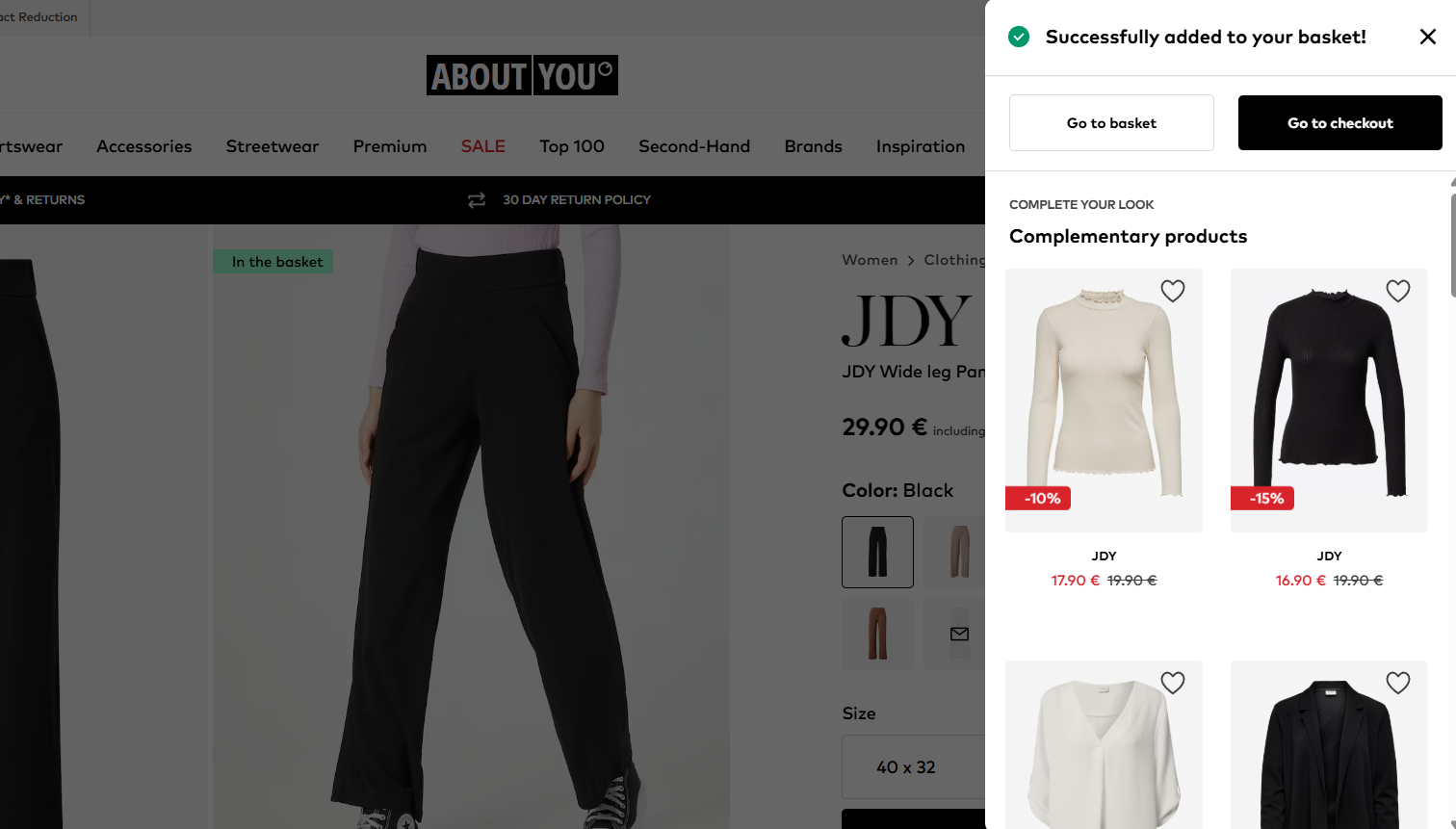
About You’s personalized product recommendations based on product type and size. Source: aboutyou.de
How you can apply this:
- Use behavioral data – Track user clicks, views, and cart additions to adjust your recommendation engine in real time.
- Create dynamic bundles – Offer personalized product sets based on previous purchases or frequently bought-together items.
- Segment and test – Use AI to build customer segments and run A/B tests on recommendation layouts, bundle offers, or timing of suggestions.
Key Tip: Include recommendation widgets on the cart, post-purchase, and product detail pages. Make sure they are contextually aware and visually consistent to maximize the impact of personalization without interfering with the user experience.
5. Dynamic Pricing
Demand, inventory, and competition are a few factors that affect pricing. Thanks to AI tools, dynamic pricing allows retailers to easily customize their prices to stay ahead of competition. Different strategies—like reacting to inventory levels, competitors, or the season—help brands boost sales and profits automatically. Thanks to new dynamic pricing features now built into many ecommerce platforms, there’s less need for manual price changes and time-consuming updates. Walmart is one of the first to implement this back in 2020, where the retail giant used real-time analytics to monitor and react to competitor pricing, resulting to a 10% increase in online sales.
How you can apply this:
- Leverage dynamic pricing software – Automate real-time adjustments to ensure prices respond immediately to demand spikes, stockouts, or competitor movement with little effort needed.
- Define clear rules and continuously monitor – Set clear rules like floor and ceiling prices, promotional triggers, or inventory levels. Refine your pricing strategies based on results, customer feedback, and market trends to maximize revenue while maintaining a positive customer experience.
Key Tip: Identify any legalities and regulations around dynamic pricing in your market before rolling out systems.
What’s Next?
AI is definitely a game-changer and something to consider when you plan an eCommerce strategy. Not sure where to get started? Write to us at moin@watersky.digital.
Talk to us about a hands-on Workshop today!
AI in eCommerce: Questions & Answers
What are the most useful AI use cases in e-Commerce today?
How can small and mid-sized brands get started with AI in e-Commerce?
Will AI chatbots replace human customer service in e-Commerce?
How does AI personalization work in e-Commerce?
Is dynamic pricing legal in e-Commerce?
How does AI visual search benefit e-Commerce brands?
This article was written by Diamanta Hykaj and Alexandra Akaoui, digital marketing analysts with strong expertise across e-commerce, digital marketing, AI applications, and multi-industry retail strategy.
Their work focuses on how artificial intelligence is transforming e-commerce across sectors such as retail, technology, FMCG, fashion, beauty, and marketplace platforms. With a strong background in data-driven marketing, customer experience, and digital transformation, they help businesses understand how to apply AI to improve efficiency, optimize performance, and deliver more personalized customer journeys at scale.