Your Social Commerce Strategy: From Scroll to Sale
Social commerce is no longer a side experiment. In 2026, it is one of the fastest-growing revenue channels in eCommerce, hence, if you are a brand looking to diversify your revenue channels, a strong social commerce strategy is a must.
TikTok Shop generated over $500 million in the United States during Black Friday and Cyber Monday 2025 alone. In Europe, it is also expanding into the Netherlands, Belgium, Austria and Poland. Instagram Shopping is maturing. YouTube has quietly become one of the most powerful product discovery platforms, particularly in tech, beauty, and lifestyle. The question for your brand is not whether to invest in social commerce. It is how to do it in a way that actually converts.
Your Social Commerce Strategy: Summary
Key Points:
- Social Commerce is NOT Social Media Marketing. The key distinction is that social commerce closes the entire purchase loop on the platform itself, compressing the journey from discovery to checkout into seconds.
- Platform Selection is Strategic. TikTok Shop, Instagram Shopping, Pinterest, and YouTube each serve different demographics and purchase intents. Brands should go deep on one or two platforms before expanding.
- Micro and Nano Influencers Drive Conversion. Creators with under 100,000 followers generate 5 to 10 times higher engagement than macro influencers and drive stronger purchase intent through authentic, trusted recommendations.
- Product Data Consistency is Non-Negotiable. Inconsistent pricing or descriptions across platforms creates friction that kills conversion and erodes customer trust.
- Live Shopping is a High-Conversion Format. Even low-production live sessions hosted by trusted creators consistently outperform polished static content in conversion rate.
Key Takeaway: The brands winning on social commerce in 2026 are not those with the biggest budgets, but those moving fastest, treating creators as genuine partners, and building the operational infrastructure to support seamless in-app purchase journeys.
What Makes Social Commerce Different from Social Media Marketing
Social commerce is not the same as social media marketing, and the distinction matters when you are allocating budget and building your team’s capabilities.
Social media marketing drives awareness and traffic. It gets users interested in your brand and, ideally, sends them to your website to complete a purchase. Meanwhile, social commerce closes the loop on the platform itself. Discovery, evaluation, and purchase all happen without the user ever leaving the app. This changes everything you need to think about regarding content, creator partnerships, product data, and fulfilment.
When a shopper can go from seeing a product in a TikTok video to completing a purchase in under 60 seconds, the entire purchase journey is compressed. Friction at any point in that journey, whether it is a slow-loading product page, a missing payment method, or a price that doesn’t match what the creator mentioned, will kill the conversion. Speed, consistency, and trust are the defining factors of social commerce success.
The Four Pillars of a Social Commerce Strategy
1. Platform Selection

TikTok Shop is one of Europe’s rising social commerce platforms. Source: Unsplash
Not every platform suits every brand. Focus on where your audience spends time, your competitors perform well, and your content gains traction.
- TikTok: Ideal for impulse purchases, trend-led categories and younger audiences who trust creators.
- Instagram: Best suited to lifestyle, beauty and fashion brands with strong visual assets and engaged communities.
- Pinterest: Effective for home, wellness and gifting, especially when shoppers are actively planning purchases.
- YouTube: Increasingly important for considered purchases, where product demonstrations help drive decisions.
Start by identifying where your audience is most active, where competitors are succeeding and where your content performs best. Then focus your budget accordingly.
2. Creator Partnerships
Micro-influencers have 10,000–100,000 followers, while nano-influencers have fewer than 10,000. Both often achieve higher engagement and stronger audience trust than larger creators.
For brands, this means shifting investment from a few expensive creators to a broader network of authentic partners. Treat creators as collaborators, not just distribution channels. Give them clear briefs, custom codes and creative freedom. Scripted or overly polished content often underperforms.
3. Product Data Consistency
Inconsistent inventory, pricing and product descriptions across your shop and social platforms create friction and erode trust. Price differences between a video and checkout can lead to abandoned purchases and lost customers.
Real-time product feeds create a competitive advantage in social commerce. Clean, consistent data improves conversion and reduces customer service issues related to pricing and availability.
4. Live Shopping
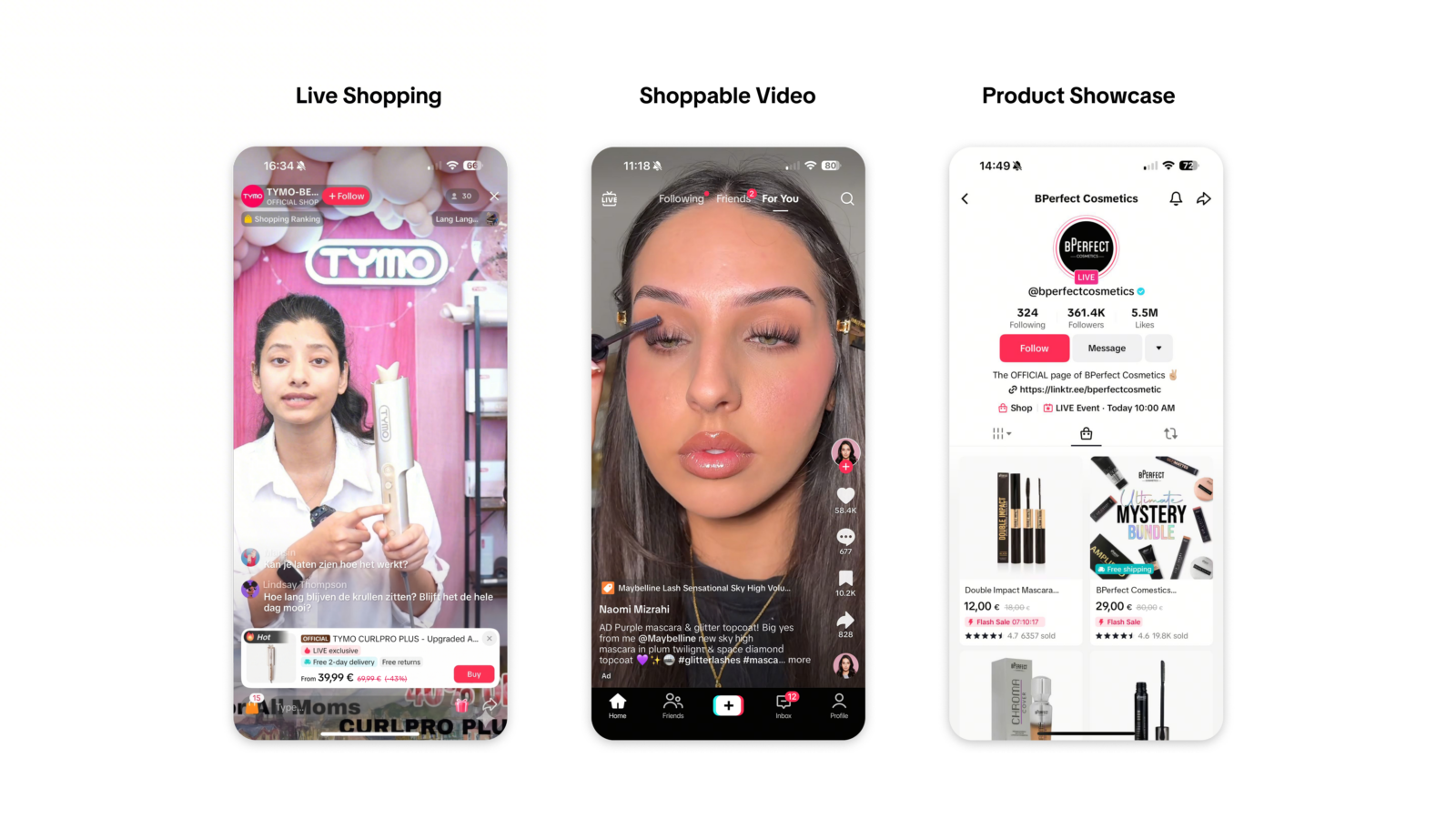
Image Source: TikTok Newsroom
Live shopping is growing rapidly in Europe, following the model already proven in China and Southeast Asia. Brands that experiment with live product demonstrations, are seeing significantly higher conversion rates than static content. The combination of creator credibility and limited-time offers creates a sense of urgency and trust that is very difficult to replicate.
Even low-production-value live sessions can outperform polished ads when hosted by a trusted creator who knows. Starting with a 30-minute pilot session requires very little investment and can generate valuable data on what resonates with your audience.
What Brands Should Do Next
- Claim your business accounts even if you are not ready to go live yet. Securing your presence now means you are ready to activate when the time is right.
- Map your top 10 SKUs to social commerce suitability. Which products have strong reviews and appeal to the demographics active on your target platforms?
- Identify three to five micro-influencers in your category and initiate a low-risk collaboration to test content formats, messaging, and audience response before committing to a larger program.
- Run a live shopping pilot of 30 to 60 minutes and measure conversion against your standard content performance to understand the incremental value.
- Track the right metrics. Saves, shares, and product page taps are often better leading indicators of social commerce intent than likes or follower counts. Build a reporting framework that captures these signals.
Social Commerce Strategy: The Bottom Line
A strong social commerce strategy in 2026 is built on the right platforms , authentic creator partnerships, consistent product data, and a willingness to experiment with live formats. The brands winning on social commerce are not the ones with the biggest budgets. They are the ones moving fastest, learning from real data, and treating creators as genuine partners in building their community.
Your Social Commerce Strategy: Questions and Answers
What is the difference between social commerce and social media marketing?
Social media marketing drives awareness and sends users to your website to complete a purchase. Social commerce closes the entire purchase loop on the platform itself, meaning discovery, evaluation, and checkout all happen without the user leaving the app.
Which social commerce platform is best for eCommerce brands in 2026?
It depends on your category and audience. The best approach is to audit where your audience already spends time and start there.
What does product data consistency mean in social commerce?
It means ensuring that your inventory levels, pricing, and product descriptions are identical and synchronized in real time across your own shop and all social commerce storefronts. Inconsistencies in pricing or availability between platforms create friction that prevents purchase completion and damages customer trust.
How should brands measure social commerce performance?
Beyond likes and follower counts, brands should track saves, shares, product page taps, conversion rate from social commerce traffic, and revenue generated per creator partnership. These metrics are more reliable indicators of purchase intent and commercial return.
Ready to build or scale your social commerce presence?
About the Author
This article was written by Diamanta Hykaj, digital marketing analysts with strong backgrounds in e-commerce, digital marketing, beauty, and retail strategy.
Their work focuses on analyzing emerging e-commerce trends, consumer behavior in online shopping, and the impact of digital transformation on modern retail businesses. They specialize in areas such as AI-driven marketing, customer experience optimization, omnichannel commerce, and data-led growth strategies.
Through research and industry insights, they help brands understand how digital innovation is reshaping e-commerce and how to adapt to evolving customer expectations in a fast-changing online retail environment.