Joybuy Europe Arrives: Can JD.com Disrupt Amazon in Europe?

Joybuy Europe marks a significant milestone in global eCommerce, as JD.com officially expands into the European Union. After mixed international results in the past, this March 2026 launch signals a more strategic, local-first, and logistics-driven approach.
Building on earlier pilots in the United Kingdom and the Netherlands, and strengthened by its stake in Ceconomy AG, Joybuy is positioning itself as a serious contender in Europe’s competitive ecommerce landscape. But the question remains: will it become a serious threat to retail giants such as Amazon? We take a closer look at early metrics and see how Joybuy fares, and the implications for retailers in the market.
Joybuy Europe Arrives Summary
JD.com’s European expansion via Joybuy is being driven by a logistics-first strategy, a premium shopper focus, competitive membership pricing, and a phased market rollout designed to challenge Amazon’s dominance.
Key Points:
- Logistics-First Approach – With 60 warehouses and its own JoyExpress last-mile delivery, Joybuy is building end-to-end supply chain control to match Amazon’s speed and reliability across Europe.
- Premium Shopper Focus – Joybuy is attracting high-intent buyers, more than double of Amazon’s, signaling a strategy built around quality over volume.
- Membership as a Loyalty Tool – The JoyPlus membership program, starting at €3.99/month, mirrors Amazon Prime’s model, offering free delivery and rewards to drive customer retention and repeat purchases.
- Phased & Localized Rollout – Unlike past failed expansions in Southeast Asia, JD.com is taking a gradual, market-specific approach in Europe, prioritizing operational excellence and local partnerships over rapid scaling.
Key Takeaway: Retailers and brands that closely monitor Joybuy’s expansion and proactively adapt their marketplace, logistics, and conversion strategies will be better positioned as European eCommerce competition intensifies.
A History of JD.com’s Global Expansion
Founded in 2004 as an electronics retailer in China, JD.com pioneered cross-border ecommerce with JD Worldwide in 2015, enabling foreign brands to reach Chinese buyers. Early pilot tests included Joybuy in the UK (2025) and Ochama in the Netherlands (2022), but faced hurdles such as poor localization. Instances such as inaccurate translations and not-so-ideal website content and user experiences were the subject of social media scrutiny during its first few months.
Previous expansions in Thailand and Indonesia also ended in market exits in 2023, largely due to:
- Weak customer service
- Operational inefficiencies
- Failure to compete against regional competitors such as Shopee, Lazada and Tokopedia
These setbacks taught the group to prioritize logistics, partner locally, and roll out gradually rather than imposing a one-fits-all Chinese eCommerce blueprint for its Joybuy Europe launch.
Joybuy’s European Strategy Shift

JD.com’s main strength is its advanced logistics network. Source: JD Corporate Blog
JoyBuy now emphasizes “logistics first,” with 60 warehouses across the UK, Germany, France, and the Netherlands for local inventory. Strengthening this advantage further, JoyBuy leverages its fully owned last-mile delivery service, JoyExpress, giving it end-to-end control over the supply chain and enabling consistent, high-quality fulfilment.
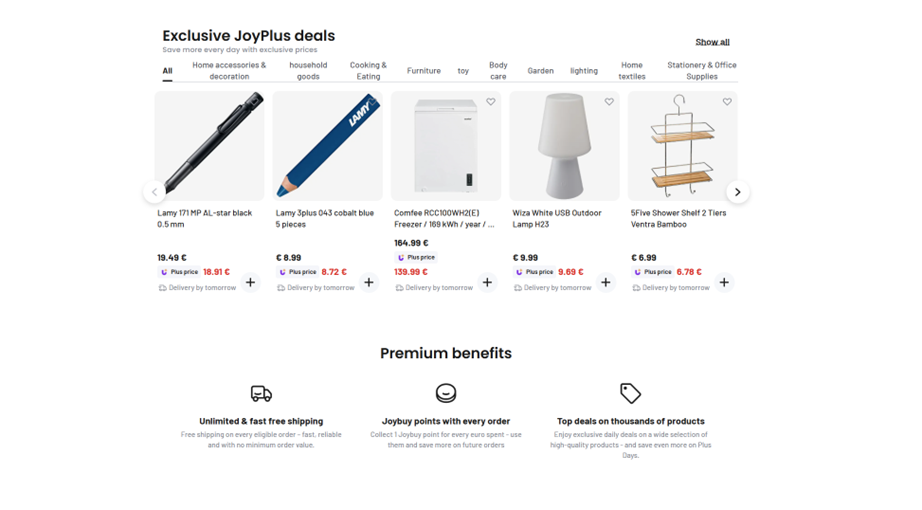
Special prices and benefits are available for Joyplus Members. Source: Joybuy.de
Rather than repeating its rapid expansion strategy seen in Southeast Asia, Joybuy is now prioritizing a phased rollout that focuses on operational excellence and customer trust. Complementing this strategy is a competitively priced membership program called JoyPlus, starting at €3.99 per month during its beta phase until the end of June 2026, and expected to rise to €9.99, which offers benefits like unlimited free delivery and reward points. This positions Joybuy Europe as a direct challenger to services like Amazon Prime, aiming to attract and retain customers through both convenience and value.
Joybuy’s Early Market Outlook in Germany
How does Joybuy compete in Amazon’s second most important market?
Customer reception is mostly positive. App store reviews in Germany average 4.9/5, with customers praising smooth orders, fast delivery, and a wide assortment of brands. Given it has not been a full year yet into its launch, its total traffic does not rival that of Amazon, eBay and OTTO. However, a comparison of shop metrics from 2025 shows Joybuy’s strong beginnings in the market.
| Number of Buyers (in thousands) |
Number of Orders (in thousands) | Net AOV (Average Order Value €) |
Purchase Frequency (times per year) |
Conversion Rate (in %) |
|
| Amazon.de | 52,626 | 1,152,503.8 | 55.4 | 22.4 | 3.4% |
| Joybuy.de | 1,118 | 3,315.6 | 132.8 | 3.0 | 3.2% |
| OTTO.de | 16,269 | 43,615 | 172.2 | 2.7 | 2.8% |
| Ebay.de | 19.743 | 197,432 | 48.0 | 10.0 | 3.2% |
A table comparing Germany’s top retailer metrics with Joybuy.de. Source: ECDB (2025 data)
With just over 1 million buyers in the past year, Joybuy has generated over 3.3 million orders, resulting in a high conversion rate of 3.2%. What truly sets Joybuy apart, however, is its exceptionally high average order value (AOV), which is more than double Amazon’s €55.4 and significantly above OTTO and eBay.
This suggests that Joybuy is not competing on volume but rather targeting higher-value purchases and more intentional shoppers. In essence, Joybuy’s early performance indicates a premium, conversion-efficient model that could become highly competitive if it succeeds in scaling its customer base without sacrificing order value. A similar advantage is also seen in other markets such as Benelux and the United Kingdom, where Joybuy also leads in basket size.
How does Joybuy compete with Amazon?
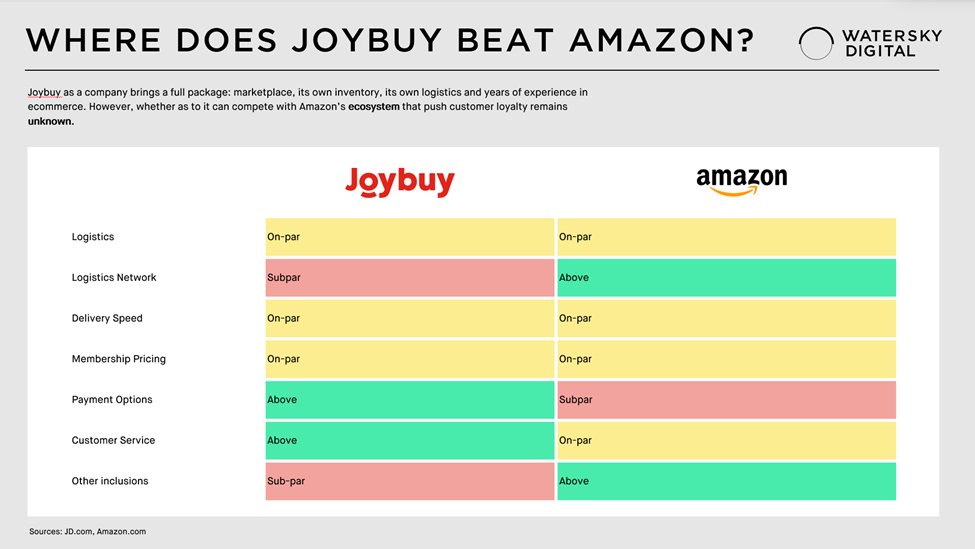
An internal comparison between Joybuy and Amazon’s key factors. Source: Watersky Digital
Joybuy matches Amazon in speed (same day in major cities), offers more payment options to customers (e.g. Klarna) and boasts 24/7 customer service. Its owned logistics also avoids third-party reliance, unlike Amazon’s hybrid FBA. Nevertheless, it is Amazon’s Prime, Video, Music, and other ecosystem components that build deeper customer loyalty and retention.
Implications for European eCommerce
Post-trial challenges facing Joybuy include penetrating Amazon-dominated markets, an expansion covering more parts of Europe while ensuring compliance, and long-term profitability beyond growth. Joybuy has done everything right during its trial launch. Is it a full challenger? The answer is hard to predict, but at this point, it is not yet.
However, it has a very high potential to become an Amazon competitor. Success here could disrupt other local players, pushing locals to enhance delivery and partnerships. For retailers in pharmacy, FMCG, and beauty, Joybuy signals Chinese platforms prioritizing. high-AOV categories via superior logistics and localization. Close monitoring is key.
For brands and retailers, now is the time to pay attention. Whether you’re exploring new marketplaces, refining your logistics strategy, or optimizing for conversion, it is a good idea to keep a close eye on this expansion and start thinking about how your business can adapt.
Joybuy Europe Arrives: Questions & Answers
What lessons did JD.com learn from its past failed expansions?
These setbacks led JD.com to adopt a phased rollout strategy, prioritize logistics excellence and partner up with local players rather than applying a one-size-fits-all approach.
What is Joybuy and when did it launch?
Joybuy is JD.com’s official expansion into the European market. It launched in March 2026, building on earlier pilot launches in the United Kingdom and Netherlands.
How does Joybuy’s early performance in the German market compare to Amazon?
While Joybuy is far smaller in volume, it stands out in two key metrics: conversion rate and average order value.
What are the implications of Joybuy’s expansion for European retailers and brands?
The blog recommends that brands and retailers closely monitor Joybuy’s growth and begin thinking proactively about how to adapt their marketplace and logistics strategies. While Joybuy is not yet a full challenger to Amazon, it has the significant potential to become one.
Want to scan for your own Amazon competitors? Talk to us!
This article was written by Mary Sugui, a digital marketing analyst with expertise in e-commerce, digital strategy, and performance marketing.
Her work focuses on analysing how emerging technologies such as AI, automation, and data-driven systems are reshaping online retail and customer behaviour. She specializes in understanding evolving digital commerce ecosystems, with a strong interest in how brands can adapt to changing consumer expectations and build scalable, future-ready e-commerce strategies.