AI Search Optimization for eCommerce: Get Found in 2026
Getting found online in 2026 means something very different than it did three years ago. While Google remains important, a growing share of product discovery now happens inside ChatGPT, Perplexity, and Google Gemini. These are AI tools that don’t show a list of links but instead generate a direct answer. For eCommerce brands, this shift is not just a marketing challenge. It is a structural one.
If your product pages, brand content, and category descriptions are not optimized for AI search, you risk becoming invisible. Not because your SEO is broken, but because the rules have changed. Brands that understood this early are already earning AI citations, showing up in zero-click answers, and building authority in channels that didn’t exist as a meaningful traffic source just two years ago.
This blog breaks down what AI search optimization means for eCommerce brands, why it matters now, and what you can do about it.
AI Search Optimization for Ecommerce: Key Takeaways
AI search optimization is the next layer on top of traditional SEO, helping ecommerce brands get discovered inside AI tools like ChatGPT, Perplexity, and Google Gemini. Brands that invest in structured, authoritative, and conversational content now will earn the AI citations that drive discovery and trust in 2026 and beyond.
Key Points:
- SEO Is Not Enough Alone. AI-generated overviews are resolving queries with zero clicks, meaning brands that rely solely on keyword rankings are losing top-of-funnel visibility to competitors who have invested in AI-readable content.
- GEO Rewards Different Signals. Unlike traditional SEO, AI search prioritizes clarity, authority, originality, specificity, and freshness over keyword density and backlink volume.
- Structured Data Is the Foundation. Clean product feeds, schema markup, and FAQ sections are the highest-priority technical investments for AI search visibility.
- Measurement Is Possible. Tools like Semrush’s AI Overviews tracker and manual query testing in ChatGPT and Perplexity allow brands to track their AI citation rate and identify gaps.
- It Is an Ongoing Discipline. AI search optimization needs to be embedded into the content creation workflow, not treated as a one-time project.
Key Takeaway: Brands that build AI search optimization into their content strategy now will compound their visibility advantage over time, earning citations across AI platforms that traditional SEO cannot reach.
What AI Search Optimization Actually Means
AI search optimization, sometimes called GEO (Generative Engine Optimization), is the practice of structuring your content so that AI systems can understand, trust, and cite it when generating answers for users.
Unlike traditional SEO, which rewards keyword density and backlink volume, AI search rewards a different set of signals:
- Clarity and structure: Can an AI parse your content in seconds and extract a clear, useful answer?
- Authority signals: Do you cite data, include expert perspectives, and demonstrate real credibility in your field?
- Specificity: Does your content answer real, conversational questions that shoppers actually ask, rather than generic keyword-stuffed phrases?
- Freshness: Is your content up to date and reflecting current market conditions, pricing, and product availability?
- Originality: Does your content offer a unique perspective, proprietary data, or a point of view that AI systems cannot find replicated across dozens of other pages?
For brands, this matters most at the product discovery and comparison stage. That is the moment a shopper asks an AI assistant something like: “What is the best moisturizer for sensitive skin under 40 euros?” or “Which running shoe is best for flat feet and long distances?” If your brand is not part of the answer, you have lost the shopper before they ever reach your page.
What AI Search Optimization Actually Means
Traditional SEO still plays a critical role in 2026. It remains one of the strongest drivers of high-intent traffic, particularly for ecommerce, and brands that have invested in strong technical foundations and content authority continue to benefit. But the landscape has changed significantly, and relying on SEO alone is no longer a complete strategy.
AI-generated overviews now resolve many informational queries with zero clicks. Fewer users scroll past the first AI summary to click on a link. Voice-based shopping, powered by AI assistants, is growing rapidly across mobile and smart home devices. And younger shoppers in particular are increasingly starting their product research inside AI tools rather than traditional search engines.
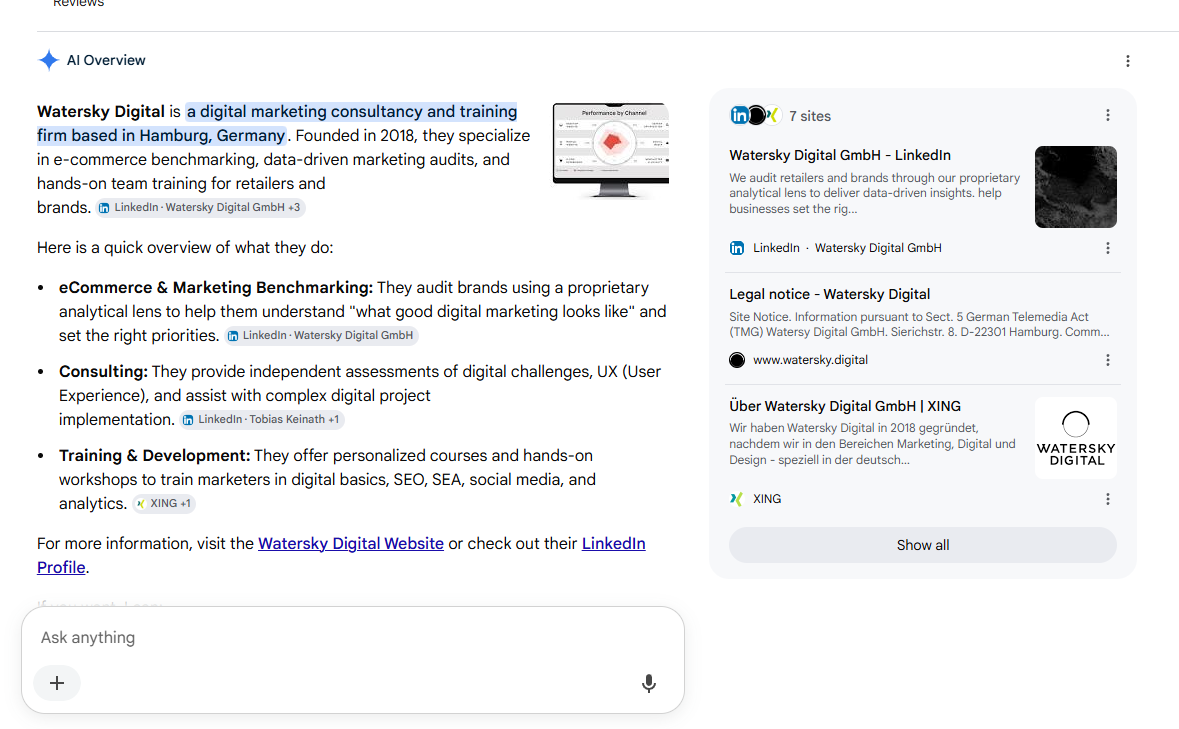
An example of Google’s AI Overview. Source: Watersky Digital
The result is that brands relying solely on keyword rankings are seeing diminishing returns on informational and top-of-funnel content. Traffic from blog posts and category pages that once drove consistent volume is flattening, while brands that have invested in AI-readable content are seeing their visibility grow in these new channels.
The solution is not to abandon SEO. It is to layer AI search optimization on top of it, treating GEO and AEO (Answer Engine Optimization) as the next stage of your search strategy rather than a replacement for what already works.
How eCommerce Brands Can Optimize for AI Search
Here is a practical framework to get started, organized by priority:
- Audit your product data first. Clean, structured product feeds with rich attributes covering materials, use cases, compatibility, benefits, and limitations are the foundation of AI search visibility. AI systems pull from structured data before anything else. If your product data is incomplete or inconsistent across platforms, this is the highest-priority fix.
- Write in a question-and-answer format. Add a FAQ section to product and category pages that mirrors how real shoppers phrase questions. Think conversational, long-tail language rather than short keyword phrases. “How long does this battery last?” performs better in AI search than “battery life.”
- Use schema markup throughout your site. Implement Product, FAQ, Review, and BreadcrumbList schema across your pages to make your content machine-readable and easier for AI systems to parse and categorize.
- Update content on a regular cycle. AI tools deprioritize stale content. A content refresh cycle, even quarterly, can significantly improve your AI visibility, particularly for product categories where pricing, availability, or specifications change frequently.
- Test live queries relevant to your products. Run manual tests in ChatGPT, Perplexity, and Google Gemini using queries your customers would realistically ask. See whether your brand appears, and if not, analyze what content is being cited and why.
Measuring AI Search Performance
Unlike traditional SEO, AI search visibility is harder to measure consistently, but it is not impossible. Tools like Semrush, BrightEdge, and Authoritas can give you directional data on how often your brand appears in AI-generated answers. Manual testing across AI platforms remains one of the most reliable methods for understanding your current visibility.
Key metrics to track as part of your AI search performance monitoring:
- Brand mention rate in AI-generated answers across ChatGPT, Perplexity, and Google Gemini
- Presence in Google AI Overviews for your core product categories and key search queries
- Conversational query rankings, particularly long-tail and question-based searches
- Changes in organic click-through rates on informational content, which can signal whether AI overviews are capturing traffic that previously came to your site
What This Means for Your Content Strategy Going Forward

Brands that build this into their content workflow now will compound their advantage over time. AI systems learn from the content they index, and brands that consistently produce high-quality, structured, citable content will find their visibility growing across both traditional and AI-powered search channels.
AI search optimization is not a replacement for SEO. It is the next layer on top of it. Brands that invest now in structured content, authority signals, and conversational formats will earn the AI citations that translate into discovery, trust, and sales. The window to build an early advantage is still open, but it will not stay open for long.
AI Search Optimization for eCommerce: Get Found in 2026 FAQs
What is the difference between SEO and AI search optimization?
Traditional SEO focuses on ranking pages in search engines like Google to drive clicks to your website. AI search optimization, also called GEO or Generative Engine Optimization, focuses on making your content trusted and citable by AI tools like ChatGPT, Perplexity, and Google Gemini, which generate direct answers rather than lists of links.
Why is traditional SEO no longer enough in 2026?
AI-generated overviews now resolve many informational queries without the user having to click any links. Brands that rely solely on keyword rankings see diminishing returns on top-of-funnel content as AI tools capture the traffic that previously came to their pages.
What types of content perform best in AI search?
Content that is clearly structured, answers real conversational questions, cites credible data, and demonstrates genuine expertise performs best. This includes FAQ sections, comparison guides, buying guides, and product pages with rich, accurate attributes.
How can brands measure their AI search visibility?
Tools like Semrush, BrightEdge, and Authoritas provide directional data on AI citation rates. Manual testing in ChatGPT, Perplexity, and Google Gemini using realistic customer queries is also one of the most reliable methods for understanding current visibility.
How often should content be updated for AI search?
AI tools deprioritize stale content, so a quarterly refresh cycle is recommended as a minimum. Product pages and category content in fast-moving categories may need more frequent updates to reflect current pricing, availability, and specifications.
Want to know how your brand currently performs in AI search optimization? Reach out to us to discuss an AI Visibility Audit!
About the Author
This article was written by Mary Sugui, a digital marketing analyst with expertise in e-commerce, digital strategy, and performance marketing.
Her work focuses on analysing how emerging technologies such as AI, automation, and data-driven systems are reshaping online retail and customer behaviour. She specializes in understanding evolving digital commerce ecosystems, with a strong interest in how brands can adapt to changing consumer expectations and build scalable, future-ready e-commerce strategies.