eCommerce in 2026: How Your Brand Can Stand Out
The Five Trends That Will Define Brand Success
In 2025, eCommerce steadily regained its growth, mainly driven by fast-paced innovation. Sounds great, right? However, the majority of this revenue was still concentrated in large marketplaces. For this reason, eCommerce in 2026 feels different, with smaller platforms falling behind giants like Amazon and Zalando. Therefore, it is important to focus on the top trends that matter, as well as the framework that can help prioritize initiatives based on your business and organizational reality. This article breaks down the five trends shaping eCommerce this year and what brands can do to act on each one
Key Takeaways – eCommerce Trends in 2026
- AI Agents and AI-Powered Search Are Changing How Brands Get Discovered:
Agentic AI tools like Amazon’s Buy For Me are reshaping how shoppers find and buy products. Brands need clean, structured, machine-readable product data and conversational content to stay visible in AI-driven search results. - Social-First and Mobile-First Commerce Is Now the Default:
TikTok Shop exceeded $500 million in sales during Black Friday 2025 alone. Brands that design their launches and content for the phone screen and social feed first and partner with micro and nano-influencers will win on social commerce. - Personalized Advertising Is the New Standard – Not the Exception:
First-party data and programmatic tools like Amazon Marketing Cloud allow brands to reach high-intent shoppers with hyper-personalized ads. Start by segmenting your existing purchase data before scaling campaigns. - Product Returns Are a Profitability Problem That Needs a Strategy:
Return rates are rising, fashion alone hits 29% in Germany. Brands that invest in better product pages, conditional return policies, and recommerce programs will protect their margins better than those who ignore the issue. - Platform Diversification Is No Longer Optional – It Is a Growth Strategy:
Brands over-reliant on one channel face growing risk. Piloting new marketplaces, social platforms, and owned D2C channels with low-risk products is the smartest way to build a resilient eCommerce portfolio.
Trend 1: How AI Agents are Changing Brand Discovery
Broader AI adoption accelerated noticeably in 2025, and as a result, it powered applications ranging from dynamic pricing to predictive inventory management. In particular, emerging tools, such as Agentic AI and AI-powered search, have therefore begun to set the stage for even deeper integration across the eCommerce value chain. Moreover, these developments are likely to enable more automated, data-driven decision-making in the near future.
Agentic AI
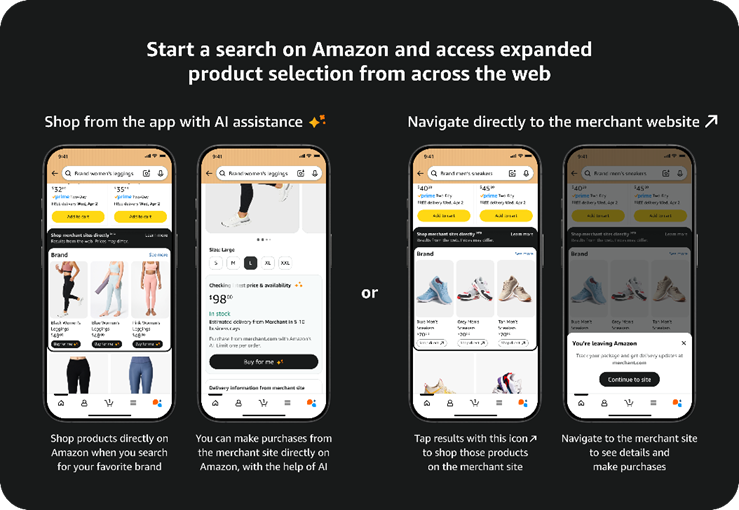
Amazon’s Buy For Me is currently available to select users in the U.S., with future rollouts planned in other markets. Source: Amazon
Over the past year, agentic AI has emerged as a transformative force, capable of executing autonomous decisions and actions with minimal human oversight. Likewise, Customer expectations have also changed. Seven out of ten online shoppers expect retailers to offer AI-powered shopping features. In eCommerce, this translates to real-time analysis of customer behavior, inventory dynamics, and pricing patterns, enabling the delivery of hyper-personalized recommendations and offers at scale. Retail giant Amazon has begun leveraging this feature with Buy for Me, enabling agents to quickly suggest additional products from various brands within the platform to customers.
AI-Powered Search
AI-Powered Search is slowly replacing Traditional SEO, because AI overviews can now deliver answers with zero clicks needed. Brand visibility hinges on the quality and organization of data. In particular, this includes clean product feeds, identifiers, rich attributes, and information regarding pricing and availability for each market. For brands to remain visible to shoppers, they need well-structured, machine-readable data that defines the product, its target audience, and its advantages. Otherwise, they risk being overlooked.
How Brands Can Stay Ahead of the Curve:
Brands can keep up with the above by prioritizing their content strategy and testing different AI agent integrations.
- Begin with testing different AI agent integrations available on your platform, or storefronts that offer agent-based tools
- Build up “trust signals” that AI agents can use by implementing structured reviews, case studies, and data optimization for products and FAQs, making listings easily parsable
- To earn a spot in AI overviews, focus on structured data for marketplaces and conversational long-tail queries
- Test agent-friendly formats: bullet-point specs, comparison tables, and micro-FAQs as these usually rank in AI overviews across different search engines
- Lastly, monitor performance. Conduct audits for conversational queries and test live queries relevant to your products (e.g. best mascara for under €30 in Germany)
Trend 2: Social-First and Mobile-First
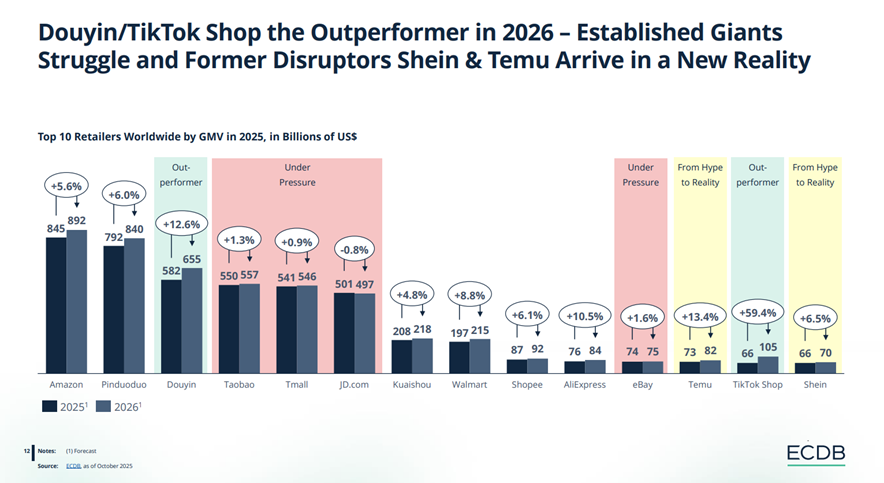
TikTok Shop has exceeded expectations in 2025, outperforming Temu and Shein. Source: ECDB
Social first, mobile first commerce is no longer a campaign choice; it is the default context in which your customers discover, evaluate, and buy. In 2026, the brands that win are those that design every launch, asset, and offer for the phone screen and the social feed first. TikTok Shop is evolving from experimentation to a powerful, integrated commerce channel. For example, in the United States, sales exceeded $500 million during Black Friday and Cyber Monday in 2025, proving the importance of live shopping and creator partnerships.

Creators on TikTok have different ways to collaborate with brands. Source: TikTok
Micro-influencers (10k–100k followers) and nano-influencers (under 10k) have become powerful in social commerce, increasing engagement rates 5 to10x and fostering genuine trust within the community, at a fraction of the investment. In an era flooded with AI-generated content, these creators excel by sharing authentic, relatable stories that resonate deeply with niche communities. For brands selling across platforms, creator partnerships have a greater chance of conversion, turning casual scrolls into repeat purchases through raw credibility that AI cannot replicate yet.
How Brands Can Stay Ahead of the Curve:
- Start with preparing and claiming your Business Accounts on social media platforms if not live yet
- Ensure consistency across platforms – unified product data across your own shop and social platforms will simplify operations and make it easier for customers to browse
- Analyze your own audience and use insights to match this with your own micro and nano-influencer partnerships strategy
- Treat creators as collaborators: Create custom codes, flash sales, and community-first content for more personal posts
Trend 3: Are Ads Actually Personal, or Just Noise?
eCommerce has become highly personalized, evolving into an engine for reaching high-intent online shoppers. Therefore, using programmatic display features on platforms such as Amazon Marketing Cloud (AMC) should become a priority for brands in 2026. In addition, first-party eCommerce data empowers brands to create custom audiences, deliver hyper-personalized targeting, and gain predictive insights. Moreover, AI enhances this approach by enabling predictive bidding, creative optimization, and cross-device personalization. Furthermore, more sophisticated tools can automatically adjust ad creatives, budgets, and placements based on purchase signals, weather, or even competitor pricing. As a result, we foresee other platforms ramping up their programs as well, including Walmart Connect and Obi.

Different types of programmatic ads. Source: Adcellerant
How Brands Can Stay Ahead of the Curve:
- If you are starting from scratch: analyze and download your last 3 to 6 months of purchase data
- Segment your customers: you can build audience buckets based on purchase amounts, order date, or top products
- Additionally, take advantage of pre-built templates on your platform using your first-party data, such as audience matching based on relevant products
- Run A-B campaigns and build user flows to test results. Afterwards, you can scale successful campaigns as you accumulate data
Trend 4: The Business Case for Product Returns
Product Returns
Returns are predicted to make-or-break brands in 2026. Average eCommerce return rates have increased globally, with Fashion being the most returned category in Germany at 29%. Global reverse logistics costs have risen proportionally, raising questions about profitability in eCommerce in 2026. Major fashion platforms have begun taking action, with ASOS and Zara implementing changes to their return policies, which have eliminated free returns in recent months. Notably, platforms have begun separating shipping costs from free returns, rather than charging explicit return fees.
Recommerce
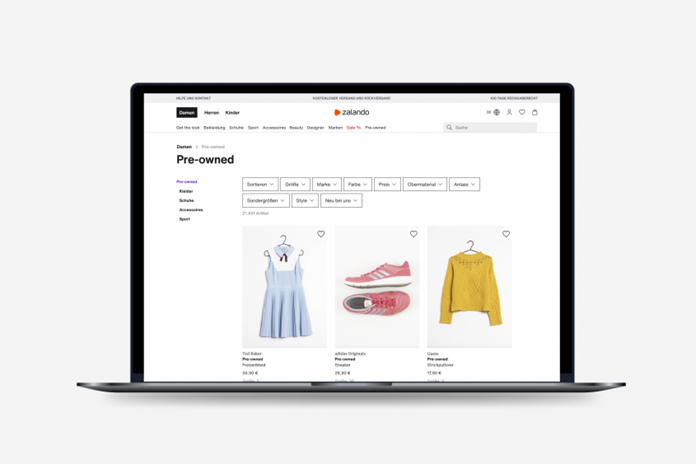
Zalando’s pre-owned category. Source: Zalando SE
Recommerce returns into revenue by reselling returned, refurbished, or pre‑owned items. Retail platforms currently implementing this include Zalando Pre-Owned, About You, and Amazon Resale. It is an opportunity for brands and platforms to earn back margins and reduce waste. As said, the most profitable return is the one that never happens. To protect profit, build trust, and minimize losses from returns, brands can take effective measures without incurring high costs.
How Brands Can Stay Ahead of the Curve:
- Optimize product pages: Use clear visuals, detailed info, and interactive tools to help your customers buy the right product
- Before writing off returns, refurbish or clean items to sell at a smaller discount
- Moreover, make free returns conditional (e.g., limited to loyalty members, minimum basket value)
- Track reasons for returns and feed insights back your channel content to prevent repeat issues and improve conversion
Trend 5: Platform Diversification As Your Growth Secret
eCommerce in 2026 will place more importance on platform diversification. Brands that depend too much on a single platform might encounter significant risks. Current trends in eCommerce indicate that shoppers seamlessly navigate between without noticing a conscious difference. Successful brands will diversify by growing on alternative platforms: be it other marketplaces, social media platforms, search or AI engines, and owned D2C channels.
How Brands Can Stay Ahead of the Curve:
- Explicitly study your actual revenue: is it evenly distributed or concentrated on one channel (>50%)?
- Invest in your own channels, such as your website, app, social media, and email database
- Pilot 2 to 3 new platforms with low-risk SKUs for a limited period
- Measure and track cross-platform clicks to map out your customer journey
Which eCommerce trends could transform your brand this year?
Undeniably, 2026 will not just be about generating more traffic. Instead, and at the same time, brands must break down internal silos because digital marketing and eCommerce are increasingly converging. Therefore, and in this context, the key for brands will be to prioritize strategically. First, they should focus on initiatives that directly impact both profitability and customer experience. Next, once these foundational capabilities are firmly in place, brands can then invest in more advanced technical initiatives, such as programmatic advertising. Finally, and over time, they can explore broader platform diversification.
How to Get Started
Eager to future-proof your team’s eCommerce performance in 2026?
Email moin@watersky.digital to discuss how we deliver results.
e-Commerce in 2026: Questions & Answers
What are the biggest e-Commerce trends in 2026?
How does AI change the way shoppers find products online in 2026?
How can brands succeed on TikTok Shop in 2026?
What is recommerce and why does it matter for e-Commerce brands in 2026?
How should brands approach platform diversification in 2026?
What is the role of first-party data in e-Commerce advertising in 2026?
This article was written by Mary Sugui, a digital marketing analyst with expertise in e-Commerce, digital strategy, and performance marketing.
Her work focuses on analyzing how emerging technologies such as AI, automation, and data-driven systems are reshaping online retail and customer behavior. She specializes in understanding evolving digital commerce ecosystems, with a strong interest in how brands can adapt to changing consumer expectations and build scalable, future-ready e-commerce strategies.